

Get a summary in:
Offshore Software Development Rates to Look Out For in 2026
Offshore software development has evolved from a cost-cutting experiment to a fundamental employment strategy for businesses of all sizes in 2026. However, this shift has also created a highly fragmented rate landscape that can make or break your budget.
If you are thinking of developing an app for your business and the idea along with your budget are approved, the next crucial step is choosing the right app development partner, like Appicoders, to develop your app exceptionally. Or you can hire any developers from any corner of the tech world. But their rates vary by region, relying on outdated benchmarks and pricing models that raise more questions than they answer.
Central and Eastern Europe: $20 - $99
Western Europe: $80 - $200
Asia: $25 - $200
North America: $100 - $300
South America: $50 - $100
If your head is popping up with too many questions, then you are on the right page. A combination of global inflation, shifting talent migration patterns, post-pandemic remote work normalization and the rising demand for AI-adjacent skills has reshuffled the pricing landscape in ways that can catch even experienced tech leaders off guard.
Not Sure What Your Project Will Cost?
Stop guessing when Appicoders, the best mobile app development company in town, is here for you. Whether you're scoping an MVP, a SaaS platform, or an enterprise build, we'll give you a detailed, honest cost estimate based on your actual requirements.
Get a Custom EstimateThis guide cuts through the noise. Whether you're a founder scoping your first offshore hire, a CTO evaluating vendors across three continents, or an engineering manager trying to justify a distributed team model to your CFO, you'll find current, practical rate benchmarks here, broken down by region, role, and engagement model.
This blog brings the cost list with no filter and this is what is needed to make a confident yet well-informed decision in 2026.
Let's get into it.
Why Offshore Development Continues to Grow
Over the past 20 years, there has been a significant change in the worldwide software development scene. Once thought to be a cost-cutting tactic only used by big businesses, this approach is now widely used by more than 500 organizations, startups and scale-ups. In an era where remote labor is the norm, offshore development is not only surviving but also growing.
Market Demand
In the majority of Western markets, the demand for software development expertise has continuously exceeded the supply. Industry researchers predict that by the late 2020s, there will be tens of millions of vacant developer positions worldwide. Every business is going through a digital revolution, from logistics and retail to fintech and healthcare, and the competition to develop, ship, and refine software products is fiercer than ever.
Due to the imbalance between local supply and demand, offshore development is now a strategic need that every company should embrace rather than a backup plan. Companies that delay developing distributed engineering teams often find themselves unable to deliver on product roadmaps while losing momentum to competitors.
Your Competitors Aren't Waiting. Neither Should You.
Every week without the right development team is a week your roadmap slips. With Appicoders, go from requirement to a fully onboarded offshore team in as little as two weeks, without cutting corners on quality.
Start Building Your TeamCost Efficiency vs. Local Hiring
There is still a compelling financial case for offshore development. Hiring a senior software engineer in Houston, Austin, Miami, sansfrasnoc, DC, New York and Chicago can pay between $150,000 and $250,000 per year by excluding company taxes, benefits, office overhead and recruiting costs. Comparable talent in Eastern Europe, South Asia or Latin America can be hired for a fraction of that cost without correspondingly compromising quality.
Crucially, the discussion has advanced beyond straightforward arbitrage. The entire value delivered—velocity, code quality, communication dependability, and long-term retention—is used to assess modern offshore engagements. Cost effectiveness is still a motivator, but it is becoming more widely recognized as one component of a larger ROI calculation rather than the only one.
Global Talent Access
What if the next big mobile app is only waiting to be planned rather than developed? Many app ideas begin with enthusiasm but even the most promising ideas may struggle to survive in the digital edge without a defined plan. The most successful apps are built on a solid foundation of mobile app development phases which includes planning, researching and clearly defining objectives rather than being developed right away.
By taking the time to understand users' needs and requirements as well as validating your idea and mapping out the features that matter most, you can turn a simple concept into a product that your users will love.
It's important to understand what offshore software development actually means before delving into rates and regional splits when you're making hiring decisions costing tens or hundreds of thousands of dollars.
What Is Offshore Software Development?
Hiring engineers or development teams of the top-tier mobile app development company in another nation to create and maintain software products is known as offshore software development. Businesses use this strategy to access people from around the world, save development costs, expedite hiring and more affordable opions effectively. Offshore development can provide excellent outcomes and offer substantial economic benefits when it is backed by the proper procedures and partners.
Offshore vs onshore vs nearshore
These three terms form the core vocabulary of global hiring while conflating them leads to unexpected surprises, budgets and timelines.
Onshore Development
Onshore development involves hiring software talent within your own country. This model offers advantages such as shared time zones, cultural familiarity, smoother communication, simpler legal processes and more. However, it is typically the most expensive option which can be a difficult one to pick skilled developers in highly competitive markets.
Nearshore Development
Nearshore development means working with teams in neighboring or nearby countries providing a balanced cost savings and collaboration efficiency which allows for real-time communication and easier project coordination. This model is ideal for companies that are looking for affordable talent without significant operational challenges.
Offshore Development
Offshore development offers access to a large talent pool while taking advantage of the high cost which makes it a popular choice for mobile app development which involves hiring teams in countries that are geographically distant and often separated by major time zone differences.
Common engagement models
Just as crucial as the location of your team is how you set up the working relationship. Your expenses, control, legal exposure, and scalability are all shaped by the engagement model. Currently, there are three main models in use.
Staff Augmentation
While the vendor takes care of hiring and administrative duties, staff augmentation enables companies to employ small teams who operate directly within their current procedures and under their supervision. Although it provides the most control and flexibility for rapidly expanding engineering capacity, it necessitates strong internal leadership to efficiently manage and coordinate the growing team.
Dedicated Development Teams
Dedicated Development Team provides a fully managed team that works exclusively on your product which often includes developers, QA engineers and project managers. It is ideal for long-term projects that require continuous development while offering a balance of cost efficiency and reduced management team.
Project-Based / Fixed-Scope Outsourcing
Project-Based (Fixed Scope) Model involves defining the full scope, timeline and deliverables upfront, with the vendor responsible for end-to-end execution and delivery. It works best for well-defined projects like MVPs, feature builds or system migrations which offers predictable costs and low management effort.
Offshore Software Development Rates in 2026 (By Region)
Asia
Vietnam: $35–50 per hour (senior), $25–35 per hour (mid-level)
India: $20–25 per hour for juniors, $30–40 per hour for mid-levels, and $40–50 per hour for seniors
Philippines: $15–20 per hour for juniors, $25–35 per hour for mid-levels, and $35–45 per hour for seniors)
Eastern Europe
Poland: $55–70 per hour (senior), $40–60 per hour (mid-level)
Ukraine: Depending on experience, $35–55 per hour
Romania: $35 to $50 per hour
Latin America
Brazil: $50–75 per hour (senior), $35–55 per hour (mid-level)
Colombia: $25 to $50 per hour
Argentina: $25 to $50 per hour
Western Europe
Mid-level: $60–100 per hour; Senior: $90–140 per hour
North America benchmark
Mid-level: $80–130 per hour; Senior: $120–200+ per hour
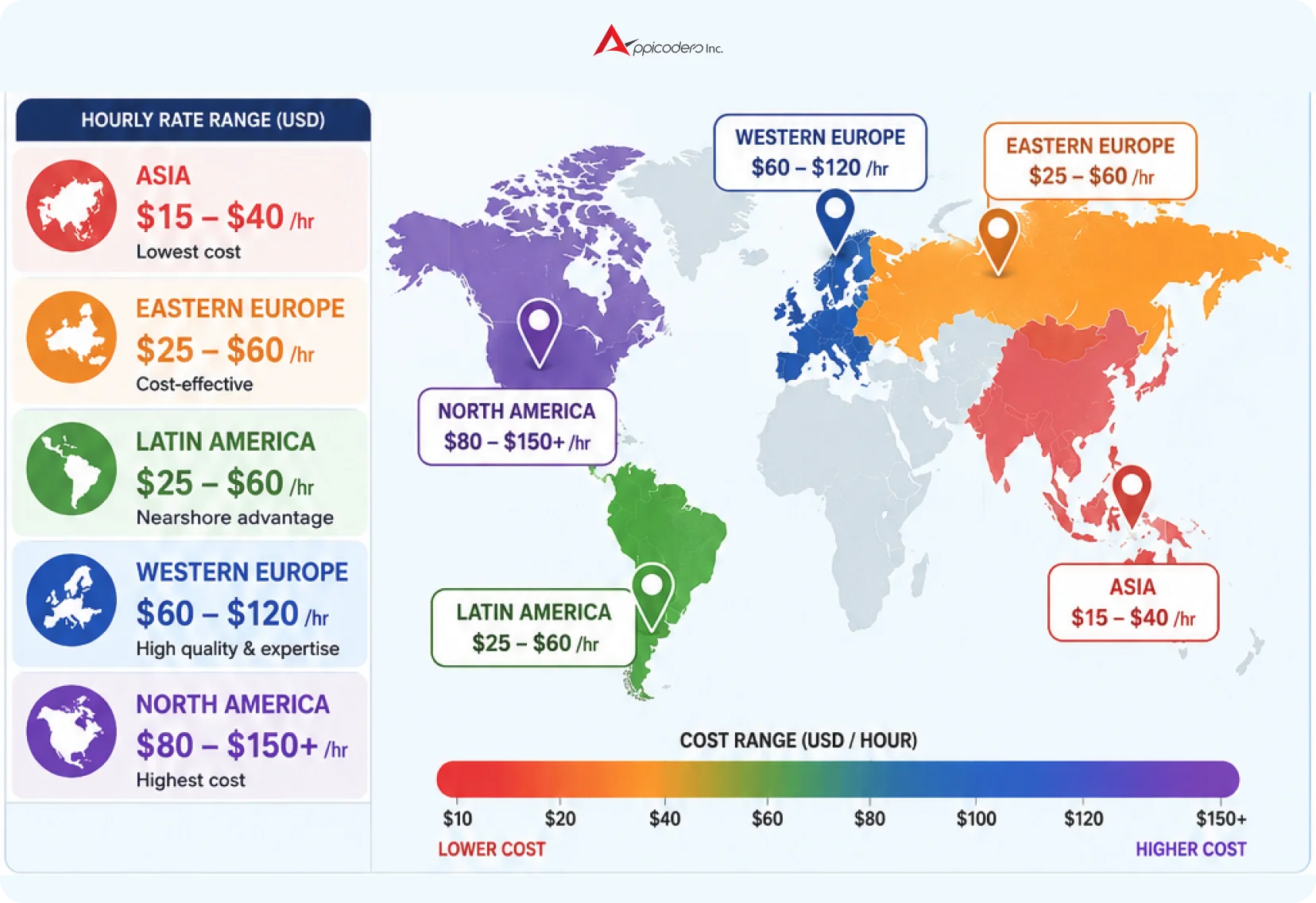
Offshore Development Cost Comparison by Country
Some of the factors that affect the offshore software development rates are:
| Factor | Key Pricing Drivers | Typical Cost Impact |
|---|---|---|
| Project Complexity | Architecture requirements, third-party integrations, scalability, and custom features | MVP/Basic Apps: $30–$50/hour* Medium Complexity: $50–$80/hour* Enterprise/High-Load Systems: $80–$150+/hour |
| Team Seniority | Experience level, technical expertise, leadership responsibilities | Junior Developers: $15–$40/hour* Mid-Level Developers: $30–$80/hour* Senior Developers: $60–$150+/hour |
| Technology Stack | Technology maturity, talent availability, and specialization requirements | Standard Technologies: $30–$55/hour* Advanced Technologies (AI, Blockchain, IoT): $50–$90+/hour |
| Team Size | Number of developers, designers, QA engineers, and project managers | Small Team (2–4 members): $5,000–$20,000/month* Mid-Size Team (5–10 members): $20,000–$80,000/month* Large Team (10+ members): $80,000+/month |
| Development Timeline | Delivery speed, resource allocation, and parallel development needs | Standard Timeline: Baseline Cost* Accelerated Delivery: +20–50% project cost* Urgent Projects: +50%+ project cost |
| Security & Compliance Requirements | Regulatory standards, certifications, security audits, legal obligations | Non-Regulated Projects: Baseline Cost* GDPR/HIPAA/PCI-DSS Compliance: +15–30% project cost* Enterprise Security Audits: $10,000–$100,000+ additional cost |
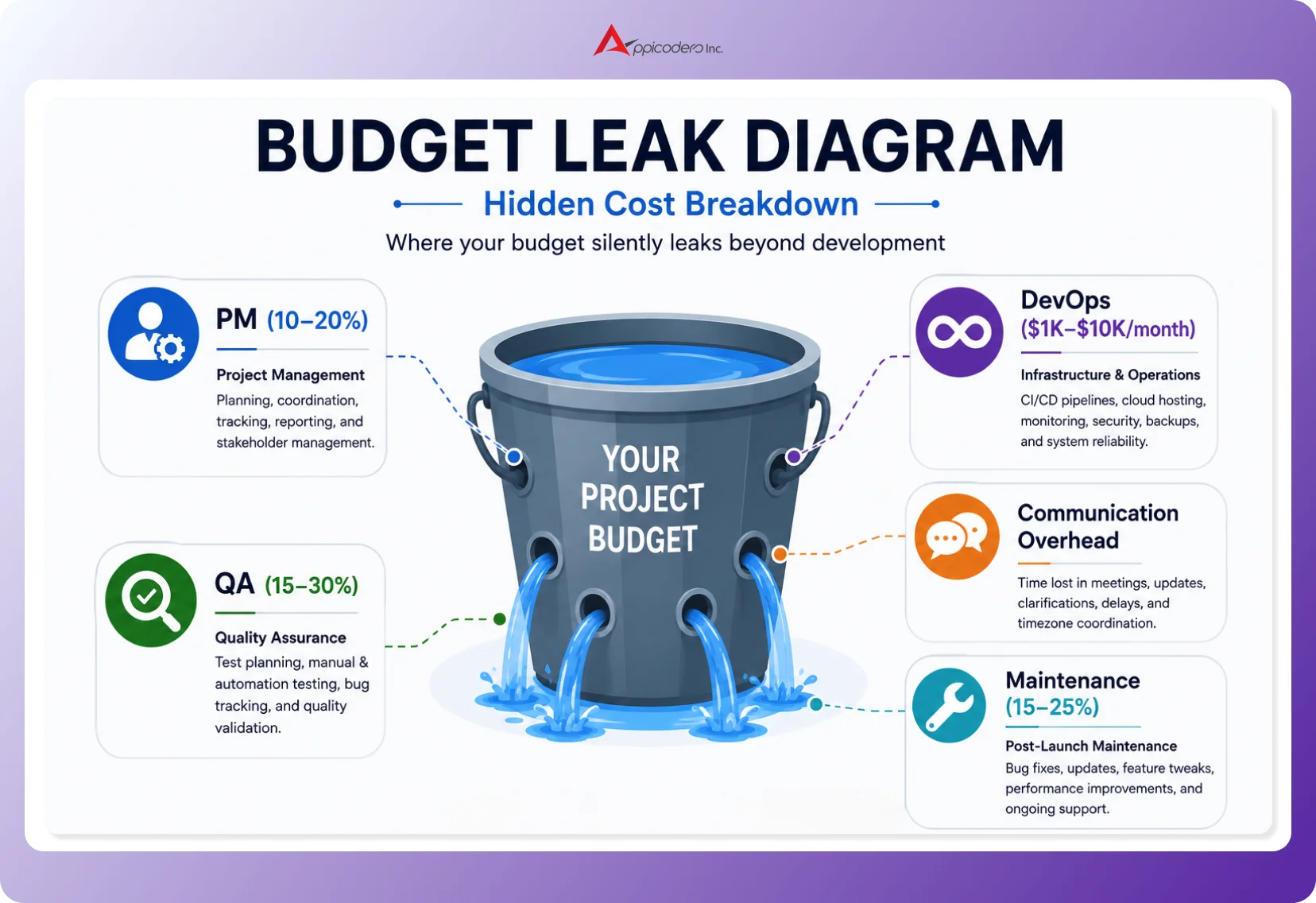
Hidden Costs Most Businesses Ignore
| Hidden Cost Area | What It Includes | Typical Cost Impact |
|---|---|---|
| Project Management | Coordination, sprint planning, reporting, stakeholder alignment, risk management | Usually 10–20% of total project cost or $3,000–$15,000/month depending on team size |
| QA & Testing | Manual testing, automation, bug fixing, regression testing, test case design | Adds around 15–30% of development cost depending on complexity and release cycles |
| DevOps & Infrastructure | Cloud setup, CI/CD pipelines, server management, monitoring, scaling | Typically $1,000–$10,000/month, higher for enterprise-grade systems |
| Communication Overhead | Meetings, time zone coordination, documentation, rework due to misalignment | Can add 5–15% extra effort to total project hours |
| Maintenance & Support | Bug fixes, updates, feature enhancements, OS compatibility updates | Around 15–25% of initial development cost annually |
Offshore Pricing Models Explained
Fixed Price
The project scope, timeline and cost are agreed upon upfront before even the development process begins, in this development model. It works best for small to medium projects with well-documented requirements and minimal expected changes, where predictability is more important than flexibility.
Dedicated Development Team
A dedicated team comes together and works collaboratively on your project while functioning like an extension of your in-house team. You get full control over priorities and workflow while the provider handles hiring and infrastructure. If you are looking for some long-term product development commitments, then the dedicated development team model works the best.
Staff Augmentation
This model allows you to quickly add individual developers or specialists to your existing team. Which helps you manage their tasks directly, while the vendor handles recruitment and administrative. It is best suited for filling skill gaps for specific areas of your project.
Time & Material
By following this model, which is commonly used for the large or complex product development that works on multiple iterations due to evolution in the demands and requirements. It is essential to consider the cost of the mobile app development based on actual hours worked and resources used. It offers maximum flexibility by making it ideal for projects where requirements are evolving or not fully defined.
Offshore vs Nearshore vs In-House Development Cost Comparison
| Model | Typical Hourly Cost | Key Advantages | Key Limitations |
|---|---|---|---|
| Offshore Development | $20–$100/hour (depending on region and expertise) | Lowest cost option, access to large global talent pool, fast scaling capabilities | Time zone differences, communication challenges, requires strong project management |
| Nearshore Development | $40–$120/hour | Balanced cost and collaboration, overlapping time zones, easier communication | Higher cost than offshore, smaller talent pool compared to global outsourcing |
| In-House Development | $80–$200+/hour (or $8,000–$20,000+ per month per developer equivalent cost) | Full control over team, strong alignment with company culture, direct communication | Highest cost, slower hiring process, limited scalability |
Tired of Quotes That Bear No Resemblance to Final Invoices?
Hidden costs, scope creep and vague pricing models are the three biggest budget killers in offshore development. We take fully care of it and build transparent proposals so you know exactly what you're paying for. Don't risk your app future, and get connected with the Appicoders team ASAP.
Get a Transparent ProposalHow to Estimate Your Offshore Software Development Budget
Knowing what you're creating, who will build it, and how long it will take is the first step in estimating the budget for an offshore project. A disciplined strategy helps you avoid surprises and manage investments properly from the beginning, even though offshore software development expenses vary by geography and complexity.
Discovery phase
This discovery phase helps create a clear roadmap that guides the entire development process. This process is crucial to clearly identify the problem your product solves and who it's for. You should also outline core features and functionalities, key user flows and system behavior in simple terms along with any third-party integrations.
Finally, identify non-negotiable constraints such as security and compliance, and performance measures, since these heavily influence cost and architecture.
Feature prioritization
Prioritizing features according to their significance and business value comes next after your product needs have been established. The MoSCoW structure ensures that essential functionalities adn components are given first by classifying features into Must Have, Should Have, Could Have and Won't Have categories. This strategy allows for quicker launches while maintaining control budgets and development schedules.
Cost estimation formula
With a scoped feature set in hand, you're ready to build a cost model. Here is the formula you can use to calculate the estimate cost of the mobile app development.
The Core Formula
Total Project Cost = Σ (Role Hours × Hourly Rate) + Overhead + Contingency Buffer
Cost Examples by Project Type
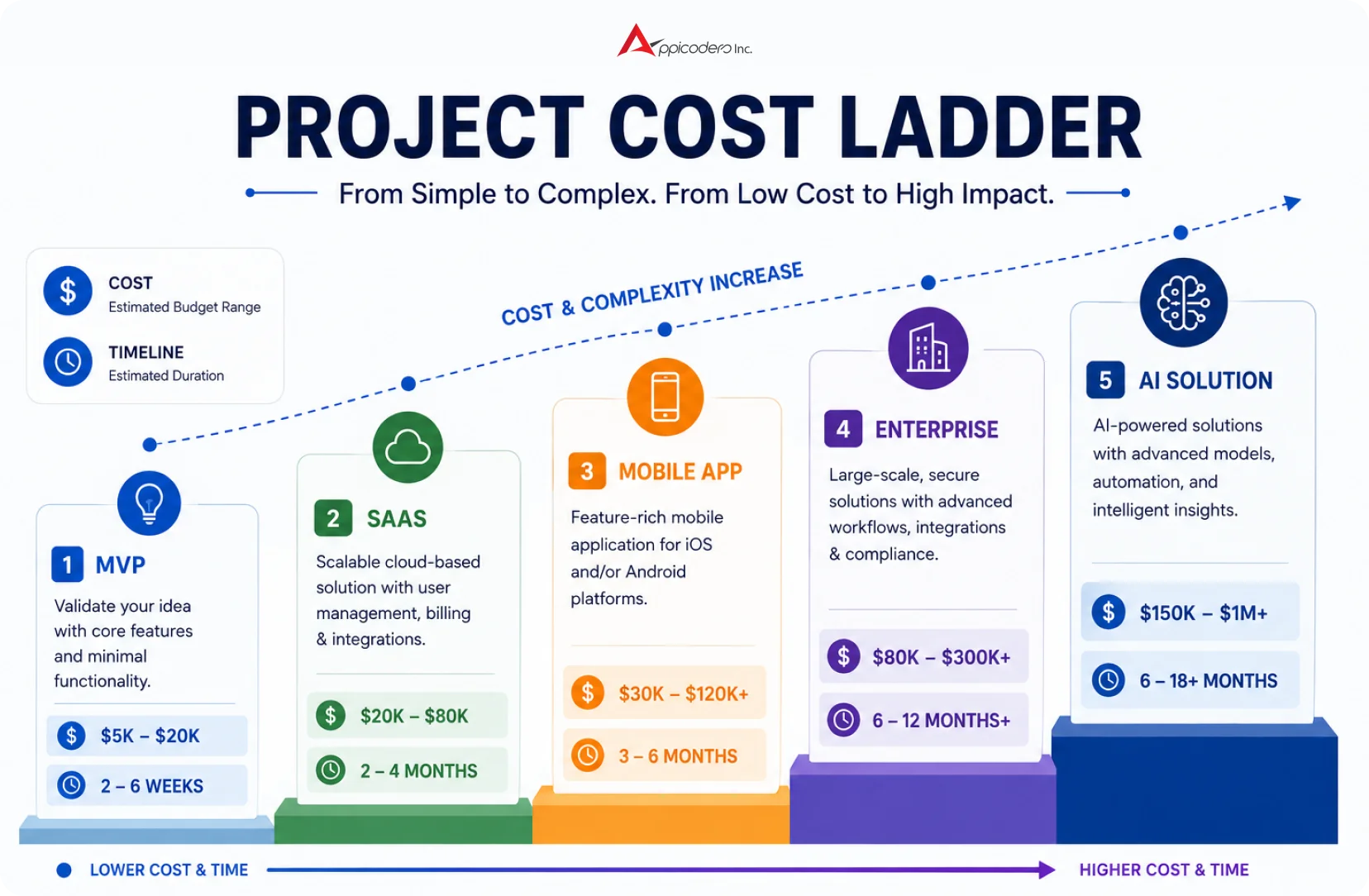
MVP Development
A simplified version of a product with essential functionality developed to validate an idea, collect user review and swiftly enter the market.
Typical Cost Range: $25,000 – $80,000
Timeline: 2 – 5 months
Mobile App
Platform (iOS, Android, or both), UI/UX complexity, third-party integrations and feature requirements all affect the mobile app development costs.
Typical Cost Range: $30,000 – $120,000
Timeline: 3 – 7 months
SaaS Platform
Comprises cloud infrastructure, dashboards, APIs, subscriptions, user management and online apps.
Typical Cost Range: $75,000 – $250,000+
Timeline: 5 – 12 months
Enterprise Software
Large-scale systems require advanced security, integrations, compliance, custom workflows, and high scalability.
Typical Cost Range: $150,000 – $500,000+
Timeline: 9 – 18+ months
AI-Powered Solution
Include data processing pipelines, generative AI, machine learning models, training, testing, continuous optimization and more.
Typical Cost Range: $40,000 – $200,000+
Timeline: 3 – 10 months
How to Reduce Offshore Development Costs Without Sacrificing Quality
1. Build an MVP First
Prioritize key features, test your concept beforehand, and refrain from investing in features that people might not require.
2. Choose the Right Region
Choose a site that strikes a balance between time zone suitability, communication, talent quality, pricing aand other complexities and factors.
3. Use Agile Delivery
To increase visibility, lower risks, and avoid expensive rework, develop in brief iterations.
4. Avoid Overengineering
To keep programming effective and maintainable, give real solutions precedence over needless complexity.
Common Mistakes When Hiring Offshore Development Teams
- Choosing a vendor based solely on the lowest price
- Failing to clearly define project requirements and scope
- Ignoring communication and time-zone challenges
- Overlooking technical expertise and industry experience
- Not checking references, portfolios, or client reviews
- Underestimating project management requirements
- Neglecting security, compliance, and IP protection measures
- Setting unrealistic budgets or timelines
- Skipping a pilot project or trial engagement
- Failing to establish clear KPIs and success metrics
Checklist: How to Choose the Right Offshore Development Partner
- Define your project goals and requirements.
- Evaluate the partner's technical expertise and industry experience.
- Review case studies, portfolios, and client testimonials.
- Assess communication skills and time-zone compatibility.
- Verify security practices and compliance capabilities.
- Understand their development process and project management approach.
- Compare pricing models and contract terms.
- Start with a pilot project or trial engagement.
- Check scalability and long-term support capabilities.
- Establish clear KPIs, deliverables, and communication expectations.
Future Trends in Offshore Software Development (2026–2027)
AI-Assisted Development
AI-powered coding, testing, and project management tools are becoming standard across offshore teams. These technologies help accelerate development, improve code quality, reduce repetitive tasks, and enable faster delivery with smaller teams.
Outcome-Based Pricing
Rather than charging solely for hours worked, more providers are adopting outcome-based pricing models tied to project milestones, business goals, or measurable results. This approach aligns vendor incentives with client success and improves cost predictability.
Hybrid Delivery Teams
Organizations are increasingly combining in-house, nearshore, and offshore talent into a single delivery model. Hybrid teams provide access to specialized skills, greater flexibility, improved collaboration, and a balance between cost efficiency and operational control.
Conclusion
For many businesses, offshore software development remains one of the most effective ways to access skilled talent, reduce development costs, and accelerate product delivery. However, success depends on more than hourly rates alone—it requires careful planning, the right delivery model, clear communication, and a trusted development partner. By evaluating factors such as project scope, team structure, hidden costs, and long-term goals, companies can make informed decisions that maximize value while minimizing risk. When approached strategically, offshore development can be a powerful tool for building high-quality software efficiently and at scale.
Still unsure? Get a custom estimate today
Contacting the experts at Appicoders is the first step toward a transparent, predictable, and successful offshore development engagement. Let's talk about your project.
Contact Appicoders ExpertsFAQs
What are the average offshore software development rates in 2026?
Rates vary significantly by region: Asia ($20–$50/hour), Eastern Europe ($35–$70/hour), Latin America ($25–$75/hour), Western Europe ($60–$140/hour), and North America ($80–$200+/hour).
Which region offers the best value for offshore development?
Eastern Europe and Latin America offer the best balance of cost, talent quality, and time zone compatibility for most US-based businesses.
What hidden costs should I consider in offshore development?
Key hidden costs include project management (10–20%), QA and testing (15–30%), DevOps and infrastructure ($1,000–$10,000/month), communication overhead (5–15%), and ongoing maintenance (15–25% annually).
How can I reduce offshore development costs without sacrificing quality?
Build an MVP first, choose the right region, use agile delivery methods, and avoid overengineering. These strategies help control costs while maintaining high quality.
What engagement model is best for offshore development?
It depends on your needs: staff augmentation for flexibility, dedicated teams for long-term projects, fixed-price for well-defined scopes, and time & material for evolving requirements.
On this Article
- Why Offshore Development Continues to Grow
- What Is Offshore Software Development?
- Offshore Software Development Rates in 2026 (By Region)
- Offshore Development Cost Comparison by Country
- Hidden Costs Most Businesses Ignore
- Offshore Pricing Models Explained
- Offshore vs Nearshore vs In-House Development Cost Comparison
- How to Estimate Your Offshore Software Development Budget
- How to Reduce Offshore Development Costs Without Sacrificing Quality
- Common Mistakes When Hiring Offshore Development Teams
- Future Trends in Offshore Software Development (2026–2027)
- Conclusion
Fraud Alert
Appicoders Inc. does NOT offer or recruit for online jobs through social media platforms, nor does it pay for app reviews or similar services. Any such offer made in our name is unauthorized and fraudulent, and Appicoders Inc. shall not be liable for any resulting loss or damage.