

Get a summary in:
HIPAA-Compliant App Development: A Complete 2026 Checklist
Anyone involved in healthcare technology should take note of this figure: 57 million. According to The HIPAA Journal, that is about how many people had their health information compromised due to breaches that were reported to the HHS Office for Civil Rights in 2025 alone. Even worse, more than 275 million records were compromised in 2024, mostly as a result of the Change Healthcare disaster.
For more than a decade, we have been providing healthcare app development services. "We'll deal with HIPAA later" has now been replaced by "show me your compliance architecture before the first sprint."
People's increased enthusiasm for federal regulations did not trigger that change. It occurred as a result of patients becoming loud, violations becoming costly, and OCR beginning to impose fines that were painful.
Our goal with this blog is to compile all of our knowledge on HIPAA-compliant app development. Not the diluted version. The actual details, including how to ship a compliance healthcare product without going over budget or losing your mind, where the money goes, what trips team up, and which shortcuts will cost you later.
According to Grand View Research, the global market for digital health is expected to reach USD 946 billion by 2030, from USD 288.55 billion in 2024. This area has money.
HIPAA-Compliant App Development: 8-Step 2026 Checklist
Build secure healthcare apps with privacy, security, compliance, and ongoing monitoring designed into every stage of development.
8 STEPS
From risk assessment to continuous compliance.
Risk Assessment Secure Architecture Testing & QA Deployment Continuous Monitoring
What Is HIPAA-Compliant App Dev?
HIPAA-compliant app development means building mobile or web applications that handle protected health information (PHI) in accordance with the Health Insurance Portability and Accountability Act. This involves implementing strict security measures, access controls, encryption, audit trails, and signing Business Associate Agreements (BAAs) with all vendors who touch patient data.
HIPAA Decoded: What It Really Means for Your Business
Health Insurance Portability and Accountability Act (HIPAA) was first introduced in 1996, back when a "mobile app" was only a Palm Pilot calculator. However, the fundamentals of the law remained relevant. HIPAA includes regulations about how you handle patient health information that is touched by your software.
Five rules sit at its center. Most development teams of healthcare app development company know about two of them. Here's the full picture:
| HIPAA Rule | What It Actually Governs | What This Means for Your App |
|---|---|---|
| Privacy Rule | Controls who accesses PHI and under what conditions | You require correct permission flows, data access regulations, and user-facing privacy controls |
| Security Rule | Sets technical, administrative, and physical safeguards for ePHI | This is where encryption standards, authentication needs, and audit trails come from. |
| Enforcement Rule | Lays out how investigations work and what penalties look like | Determines how much trouble you're in if something goes wrong. |
| Breach Notification Rule | Dictates breach reporting timelines and procedures | Your app needs incident detection and notification workflows baked in |
| Omnibus Rule | Extends compliance obligations to business associates | A BAA is required for every third-party API, cloud provider, and analytics tool. |
The rule that bites people is the Omnibus Rule. Even though your app is securely locked down, what if neither your analytics SDK nor your push notification supplier have a signed Business Associate Agreement? You're still responsible.
HIPAA Isn't a Feature You Add Later. Why?
The number of times a client has contacted us after attempting to retrofit HIPAA into a program that was already in production is uncountable. It's never successful. It is not intended for the architecture. Field-level encryption is not supported by the database. There is no audit tracking. Suddenly, a "quick compliance fix" becomes a six-month reconstruction.
Depending on who you ask, the significance of HIPAA compliance varies:
- Patients — control over their medical records. They have 30 days to request access, request updates, and choose how their data is disseminated. People notice when your app takes that seriously.
- Healthcare providers — avoid penalties, but the bigger win is operational. Standardized data handling that comes with fewer incidents and faster response when something does go wrong and eligibility for value-based care partnerships that require strict governance.
- App owners — enterprise discounts are unlocked. Without a compliance story, big health systems won't consider your product. Promising apps have lost six-figure contracts due to their inability to provide their BAA documentation or generate a SOC 2 report. Developing compliance from the outset is not only the morally correct thing to do, but it is also the economically wise thing to do.
The Must-Have Skillset for HIPAA-Compliant App Development
Custom HIPAA compliant app development experts ensure compliance with regulations that require individuals who are knowledgeable about both technical and regulatory aspects.
| Skill | Why You Need It | Who Fills the Role |
|---|---|---|
| Healthcare domain knowledge | Recognizing PHI data types, healthcare workflows, and the real workings of providers | Business analysts, domain consultants |
| Security engineering | Threat modeling, access controls, encryption, and other measures that protect PHI | Security engineers, pen testers |
| Cloud architecture (HIPAA-eligible) | Using the appropriate BAAs to build compliant infrastructure on AWS, Azure, or GCP | Cloud architects, DevOps engineers |
| Regulatory compliance | Converting HIPAA legalese into technical specifications that your team can implement | Compliance officers, healthcare attorneys |
| EHR/API Integration | Using HL7 FHIR to connect to Epic, Cerner, or other systems without causing any problems | Backend developers, integration specialists |
| Mobile development | Builds for iOS and Android that include certificate pinning, biometric authentication, and secure storage | Mobile engineers, UX designers |
| Security-focused QA | Beyond functional testing, vulnerability scanning, and compliance validation | QA engineers, security analysts |
Breaking Down the Real Price of HIPAA-Compliant Apps
Alright, so everyone wants to know how much it costs to create a healthcare app with HIPAA compliance. Since accessing actual ranges necessitates precise blueprints, we will provide you with approximate ranges.
| Complexity | What You're Building | Cost Range | Timeline |
|---|---|---|---|
| MVP / Basic | Single platform, core features, foundational compliance | $50K – $120K | 3–5 months |
| Mid-Range | Multi-platform, EHR integration, robust security layer | $120K – $350K | 5–9 months |
| Enterprise | Full feature suite, AI/ML, multi-system integrations | $350K – $800K+ | 9–18 months |
| Large Health System | Multi-tenant, analytics, custom clinical workflows | $800K – $3M+ | 12–24 months |
Where Does the Money Go?
- Compliance overhead, which includes encryption, audit trails, BAA administration, and pen testing, adds 15–25% to the typical app development costs.
- Depending on how many systems you're integrating, EHR integrations (Epic, Cerner, Allscripts via HL7/FHIR) can cost between $30K and $100K+.
- Third-party services that are HIPAA-tier are more expensive. For instance, Twilio's HIPAA edition is more expensive than regular price.
- For continuous audits, patches, monitoring, and regulatory updates, annual maintenance costs between $4K and $12K+.
- Professional penetration testing costs between $15,000 and $50,000 per contract (and you need it at least once a year).
The problem is that you won't save money by avoiding these healthcare app development fees. It merely postpones it. The most costly data breaches in any industry continue to occur in the healthcare sector. When it comes to software development, the math nearly always supports making an upfront investment in HIPAA compliance.
The Rules You Can't Skip in HIPAA-Compliant Mobile App Development
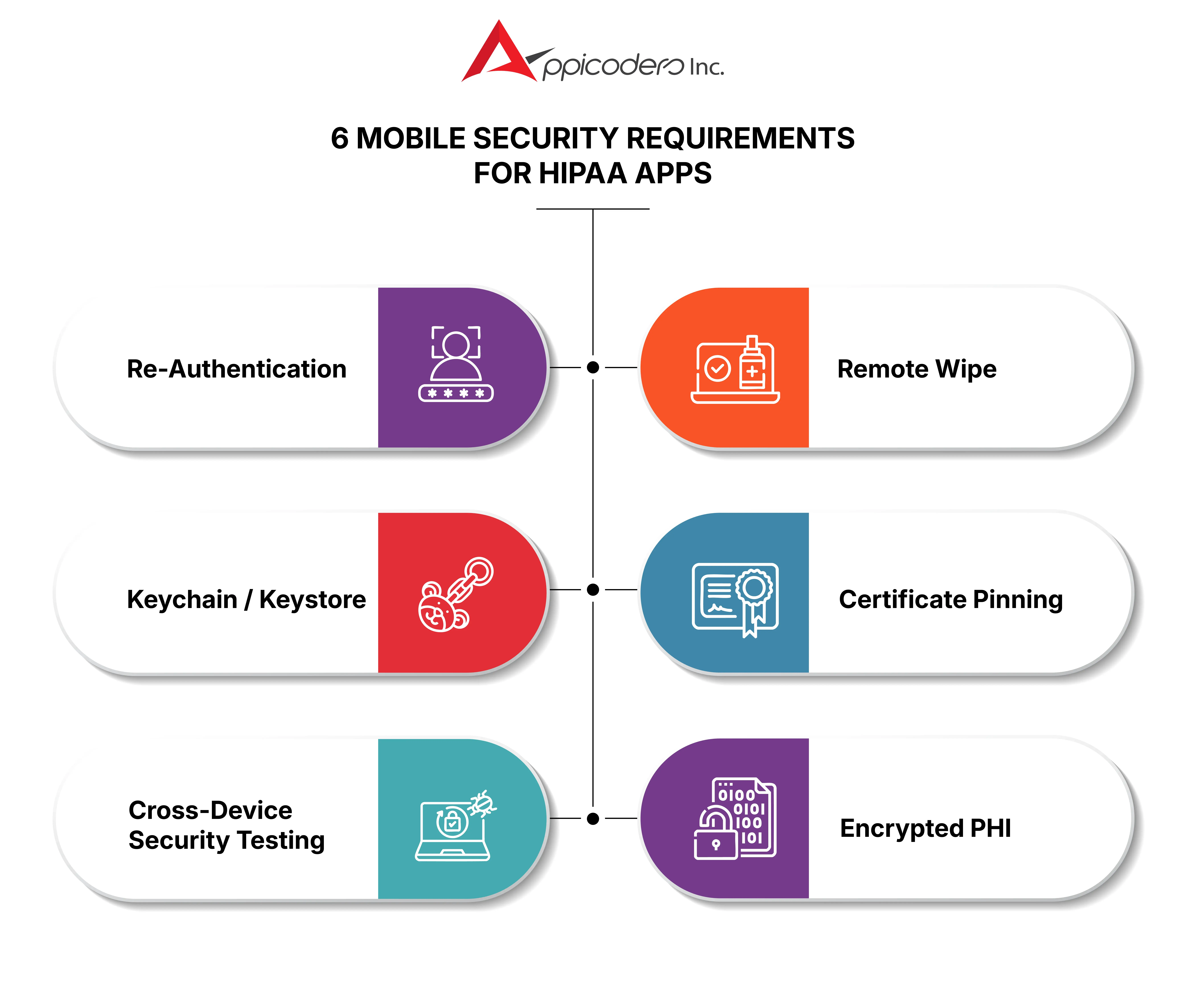
An additional element of risk is introduced by mobile. Devices are traded, lost, and stolen. Every mobile healthcare app must have the following features:
- The ability to remotely delete lost or stolen devices
- Pinning certificates to prevent man-in-the-middle attacks
- The device does not cache PHI unless it is encrypted in a secure enclave.
- Once the application has been backgrounded, re-authentication is necessary.
- Only storing credentials in the Android Keystore or iOS Keychain
- Testing to verify consistent security behavior across OS versions and device kinds
HIPAA App Development Roadblocks and How to Get Past Them
We have a fairly clear image of the areas where teams struggle after ten years and hundreds of hospital buildings. These are the issues that keep coming up and the fixes that have helped us:
| The Challenge | Why It's Hard | Solutions |
|---|---|---|
| Usability vs. compliance | Security controls add friction. Clinicians won't use clunky tools | Healthcare-specific UX research. Design security to be invisible, biometrics over passwords, smart session management |
| Data scattered across systems | PHI sits in EHRs, labs and pharmacies, each with different formats | Adopt HL7 FHIR as the interoperability backbone. Use middleware for data normalization across sources |
| Regulations keep changing | HIPAA evolves. State laws add complexity. OCR shifts enforcement focus | Dedicated compliance monitoring. We subscribe to regulatory tracking and adjust controls proactively |
| Third-party vendor risk | Every SDK, API, and cloud tool must be HIPAA-eligible with a BAA | Vendor compliance registry. Annual audits of every partner's compliance status |
| Staying compliant post-launch | Threats evolve, staff turn over, systems age | Continuous monitoring, quarterly reviews and living risk registers updated after every incident |
| Cost overruns from late compliance | Bolting security onto existing code is 3–5x more expensive | Security-by-design from sprint one. Compliance gates in the CI/CD pipeline |
Also Read: Building Healthcare Apps for Influenza Monitoring: Key Features & Challenges
Get HIPAA Wrong, and Here's What It Costs You
Let's discuss the aspect that no one wants to consider. Penalties for HIPAA violations as of 2026 vary from $145 to $2,190,294 per violation, not per event. Intentional misuse of PHI can result in criminal penalties of up to $250,000 and ten years in jail.
| Tier | Level of Fault | Per Violation | Maximum per Violation | Annual Cap |
|---|---|---|---|---|
| 1 | Didn't know (and couldn't reasonably have known) | $145 | $73,011 | $2,190,294 |
| 2 | Reasonable cause (not willful neglect) | $1,461 | $73,011 | $2,190,294 |
| 3 | Willful neglect, corrected within 30 days | $14,601 | $73,011 | $2,190,294 |
| 4 | Willful neglect, NOT corrected | $73,011 | $2,190,294 | $2,190,294 |
Source: HHS Office for Civil Rights, revised January 2026 (with cost-of-living adjustment for 2025)
How Appicoders Can Help You Get HIPAA Compliance Right
Over the course of our more than ten years in the healthcare technology industry, we have shipped more than 250 projects and developed a workforce of more than 1,600 engineers with a focus on the healthcare vertical. The depth that enables us to manage the confluence of clinical workflows, legal regulations, and intricate technical architecture that HIPAA-compliant app development necessitates is not a vanity statistic.
In actuality, working with us looks like this:
- We have developed HIPAA-compliant, production-ready DiabeticU, YouCOMM, Soniphi, and Health-e-People with no security incidents.
- Complete delivery from UX design and compliance strategy to development, quality assurance, security testing, and post-launch assistance
- Our basic engagement model incorporates BAA-ready agreements with AWS, Azure, and Google Cloud.
- ISO 27001 and ISO 9001 certifications, as well as consecutive Deloitte Tech Fast 50 Awards in 2023 and 2024
- With our healthcare app development services, you can launch a new telehealth platform, update a patient portal, or bring an existing app into compliance. We've done this many times before and are aware of the challenges.
Conclusion
HIPAA compliance is not a final checkbox but it's a foundation for building secure, trustworthy healthcare apps. From architecture and data protection to vendor management and ongoing monitoring, every decision matters. HIPAA compliant app development from day one helps avoid costly risks and create products patients and providers can trust.
Ready to Build a HIPAA-Compliant Healthcare App?
Whether you're a startup, health system, or established provider, investing in a secure, compliant mobile app can transform patient engagement and operational efficiency. Let's make it secure from the start.
Contact us today for a free consultationFraud Alert
Appicoders Inc. does NOT offer or recruit for online jobs through social media platforms, nor does it pay for app reviews or similar services. Any such offer made in our name is unauthorized and fraudulent, and Appicoders Inc. shall not be liable for any resulting loss or damage.