

Get a summary in:
Healthcare App Development Cost in 2026: Complete Guide for Startups & Enterprises
The healthcare sector has seen the most significant change in its history. What began as a drive for telehealth and remote monitoring during the pandemic has developed into a comprehensive rethinking of patient access to treatment. By 2026, mobile health apps will be the main point of contact between insurers, patients and providers. More than 3.7 billion people use healthcare applications globally and it is predicted that the global digital health market will be $861 billion by 2030. Now the question for businesses is no longer whether to develop a healthcare app but rather how much it will cost to develop a successful one.
From the early stage to the established hospital networks, businesses across the healthcare spectrum are pouring investment into mobile apps due to the real and measurable return on investment. A well-built app doesn't just improve patient outcomes but it opens new revenue streams by adding functionalities, ensuring exceptional user experiences and keeps them loyal to the platform for a longer time. Add in the growing pressure from regulators mandating digital records and it becomes clear why healthcare app development has become one of the most active corners of the tech industry in 2026.
Quick Overview of Healthcare App Development Costs
But cost is never a single number; it's a map of decisions. Healthcare app development costs can vary widely depending on multiple factors which includes features, complexity, technology used, the developers of the custom healthcare app development company like Appicoders, and more. Furthermore, additional features or functionalities, platform whether iOS or Android, security compliance like HIPAA and third-party integrations may also have an impact on the healthcare app development cost.
To help you with a smart investment with confidence and develop wisely, we have broken down every factor that affects your final budget for you.
Get Your Free Cost Estimate in 24 Hours
Not sure what your app will cost? Share your idea and get a detailed estimate with no strings attached, fast and most of all, free.
Get Free Estimate →Average Healthcare App Development Cost in 2026
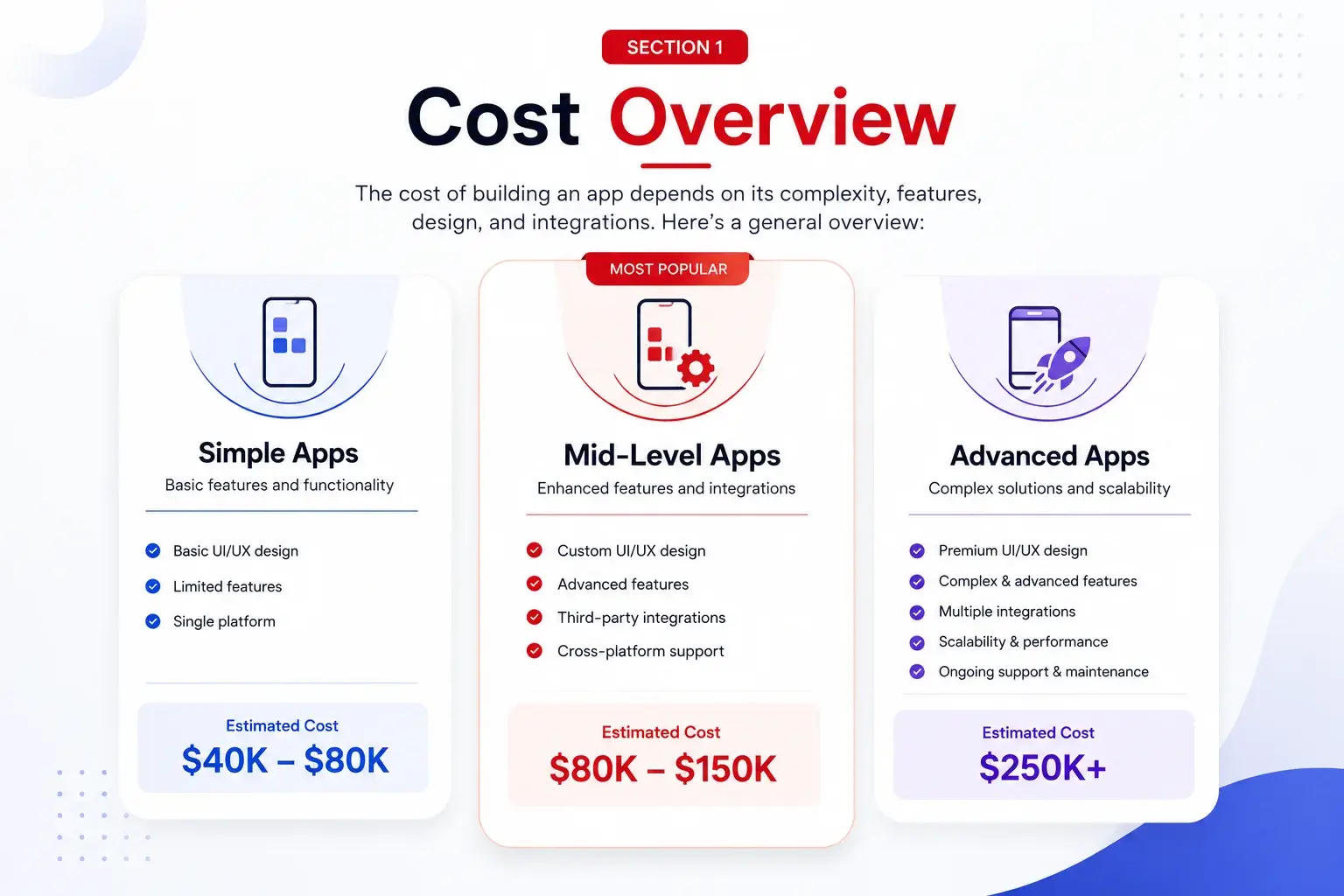
The cost of healthcare app development depends on complexity, features, target user base and market needs. For startups and healthcare providers, mid-level healthcare app development typically cost between $80,000 and $150,000. Simple apps like symptom checkers, wellness trackers, or appointment booking systems usually range from $40,000 to $80,000. Whereas, advanced healthcare app solutions like telemedicine platforms, EHR systems or others that are incorporated with advanced technologies such as AI, ML, online video cam consultation and real-time data may exceed $250,000 or above.
Healthcare apps require more investment and time for development than standard apps due to strict security, compliance and performance requirements.
| App Type | Estimated Cost |
|---|---|
| Simple Healthcare Apps | $40,000 – $80,000 |
| Mid-Level Healthcare Apps | $80,000 – $150,000 |
| Advanced Healthcare Solutions | $250,000+ |
MVP vs Full Healthcare App Cost Comparison
Before investing in the healthcare mobile app development, it is essential to validate your idea in the market, to learn what your targeted audiences are looking for, also if the idea aligns with the evolved digital market. Making an informed decision between the MVP or the complete application can be a difficult one but crucial at the same time.
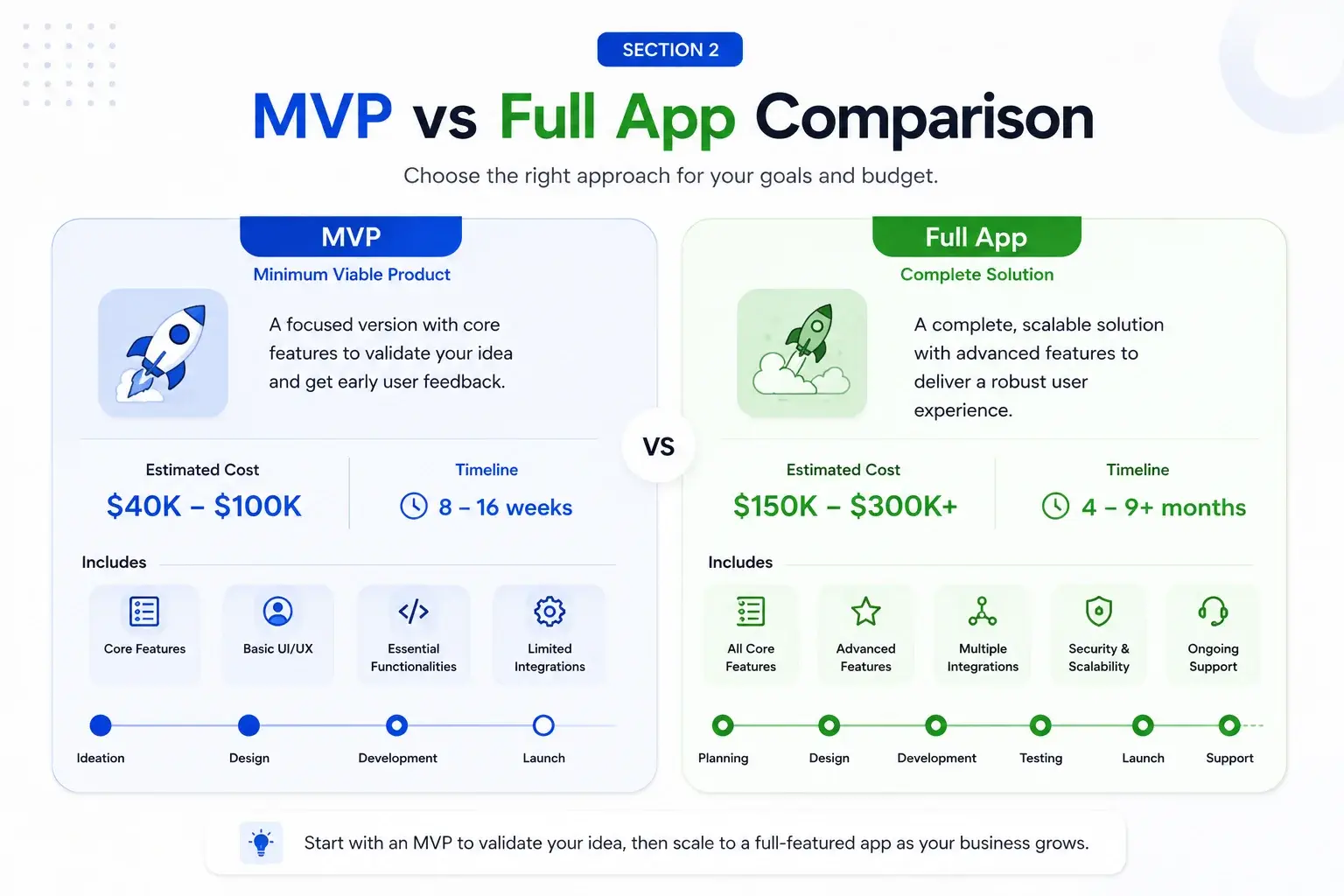
An MVP is a condensed version of your healthcare app with just the essential features and functionalities. For rapidly and affordably testing your idea in the market, this version is effective which usually costs between $40,000 and $100,000. Before developing your idea, it enables entrepreneurs and healthcare providers to verify consumer demands, obtain feedback, and lower development risks.
On the other hand, a fully competitive healthcare app is an innovative solution that may include advanced capabilities like AI diagnostics, telemedicine, EHR integration, real-time data syncing, enhanced security compliance and more. And costs would definitely increase depending on the capabilities and versions of the applications, which typically range from $150,000 to $300,000+.
MVPs are developed to help businesses launch their app idea as fast as possible, whereas a fully developed app delivers long-term reliability and a more comprehensive user experience. Therefore, it is important to make the right choice which totally aligns with your business goals, budget and growth strategy.
| Feature / Factor | MVP Healthcare App | Full Healthcare App |
|---|---|---|
| Purpose | Validate the idea and test the market demand | Deliver a complete, scalable solution |
| Features | Core/basic features only | Advanced features like AI, telemedicine, and EHR integration |
| Development Cost | $40,000 – $100,000 | $150,000 – $300,000+ |
| Development Time | Short (8–16 weeks approx.) | Longer (4–9+ months) |
| Complexity | Low to moderate | High |
| User Feedback | Early-stage testing and validation | Optimized user experience based on mature requirements |
| Scalability | Limited, designed for initial growth | Highly scalable for long-term expansion |
| Best For | Startups, idea validation, pilot projects | Established healthcare businesses, large-scale platforms |
Healthcare App Cost Based on Complexity
The development time and cost of a healthcare app are significantly influenced by its complexity. In other words, the more features and intelligence are added, the more money and time you will need.
Simple Healthcare App like a symptom checker, appointment booking or wellness tracker, usually takes around 2 to 4 months to design, develop and launch.
It can take 4 to 7 months to develop a mid-level application with more features and functionalities which includes user dashboards, payment integration, basic data management and more.
Advanced healthcare solutions like telemedicine platforms, AI-powered diagnostics, EHR-integrated systems and other healthcare platforms may take 8 to more than 12 months, as they require continuous testing, strong security implementation and regulatory compliance such as HIPAA standards.
Why Healthcare Apps Cost More Than Traditional Apps
Healthcare apps can be more expensive than traditional healthcare applications because they operate in a high-level, security-critical and data-sensitive environment where compromise is not even an option. Whereas, standard apps must comply with strict regulations such as HIPAA and other healthcare data protection laws, which require additional development time, documentation and auditing to ensure patient privacy and legal compliance.
On top of that, healthcare apps demand advanced security measures and other compliance standards to create a protection wall from breaches and unauthorized access to sensitive medical data. They also need smooth integration with complex healthcare systems like EHR/EMR platforms, hospital databases and insurance systems, which is a plus for the healthcare apps because it adds another layer of technical complexity.
Features like timely communication and consultation via video cam connection, telemedicine services require high-performance infrastructure to ensure lag-free interactions between doctors and patients. Besides features, there are multiple other factors that affect the cost of healthcare app development, let's dive in together to learn about those factors.
Key Factors Affecting Healthcare App Development Cost
The cost to build a healthcare app is not determined by hours alone, but several other factors are also considered that influence the overall time, effort and technical complexity involved. While these elements form the foundation of any estimate, mHealth app development is a layered process where every feature, integration, and architectural decision contributes to the final medical app development cost.
App Features and Functionalities
The overall cost of healthcare app development largely depends on the range of features and functionalities that are included in the telemedicine application. As the complexity grows, so does the need for stronger infrastructure and specialized technical expertise. Let's break down the telemedicine app development cost according to the features and functionalities.
| App Type | Estimated Cost | What's Included (Key Features) |
|---|---|---|
| Basic Features (MVP) | $40,000 – $80,000 | User registration and login, simple user profiles, appointment scheduling system, basic medication reminders, push notifications etc |
| Moderate Features (Mid-Level) | $80,000 – $250,000 | Everything in MVP plus secure video consultations, in-app messaging, EHR/EMR integration, payment gateway integration, and more |
| Advanced Features (Enterprise-Grade) | $250,000 – $500,000+ | All mid-level features plus AI-powered diagnostics, symptom prediction tools, IoT and wearable integration, advanced analytics, and multi-system hospital integration |
UI/UX Design Complexity
UI/UX design is highlighted as a core step in the healthcare development process and it heavily influences how users interact with the software. Therefore, it is necessary to keep the app as simple as possible to make it easier for users of all ages, even with less technical skills.
| Component | Cost |
|---|---|
| Standard Design | $5,000 – $10,000 |
| Advanced Design (3D, animation) | $30,000 – $50,000 |
| Research & Prototyping | $10,000 – $30,000 |
Backend Development Requirements
The backend serves as the foundation of any healthcare application that helps in managing data storage, user authentication, integrations, security and timely communication. The complexity of the backend directly impacts medical app development cost, especially when advanced requirements and data management are involved.
| Backend Complexity | Features Included | Estimated Cost |
|---|---|---|
| Basic Backend | User authentication, patient profiles, appointment scheduling, basic database management, notifications | $8,000 – $20,000 |
| Intermediate Backend | Secure APIs, payment gateway integration, telemedicine support, cloud storage, analytics dashboard | $20,000 – $50,000 |
| Advanced Backend | EHR/EMR integration, real-time health monitoring, AI-driven insights, role-based access control, HIPAA compliance | $50,000 – $100,000+ |
| Enterprise-Grade Backend | Multi-hospital support, IoT device integration, blockchain security, predictive analytics, high-volume data processing | $100,000 – $250,000+ |
Scalability and Cloud Infrastructure
With time, these health applications should be able to tackle challenges such as increasing number of users, patient records, timely data processing and third-party integrations without compromising quality, performance or security standards. The choice of services such as cloud, storage requirements, security measures, server capacity and more significantly impact the overall telemedicine app development cost.
| Cloud Infrastructure Level | Suitable For | Key Features | Estimated Cost Impact |
|---|---|---|---|
| Basic Cloud Setup | Small clinics, MVP healthcare apps | Cloud hosting, basic database management, automated backups | $5,000 – $15,000 |
| Standard Scalable Infrastructure | Mid-sized healthcare providers | Auto-scaling servers, API integrations, enhanced security, data encryption | $15,000 – $40,000 |
| Advanced Cloud Architecture | Telemedicine and healthcare platforms | Real-time data processing, multi-region deployment, disaster recovery, and high availability | $40,000 – $80,000 |
| Enterprise-Grade Infrastructure | Large hospitals and healthcare networks | AI-ready infrastructure, HIPAA-compliant cloud environment, advanced monitoring, extensive data storage | $80,000 – $150,000+ |
Compliance and Security Requirements
Simplified security procedures, constant monitoring, data encryption and frequent compliance updates are all essentially needed to comply with regulations like HIPAA, GDPR, and other healthcare data protection legislation. These requirements add to the initial creation and continuing maintenance expenses.
| Component | Cost |
|---|---|
| Compliance Setup (HIPAA/GDPR readiness) | $15,000 – $50,000 |
| Annual Maintenance & Updates | 15–25% of the total project cost yearly |
| Security Infrastructure | $20,000 – $80,000+ |
| Data Protection Systems | $100 – $5,000+ monthly |
Build HIPAA-Compliant From Day One
Don't let compliance slow you down. We handle the complexity so you can focus on changing healthcare.
Build Securely With Us →Third-Party Integrations
Third-party integrations play a significant role in the overall healthcare app development cost. Modern apps often depend on external services to provide essential elements to make the platform perform at the next level, such as payment processing, electronic health records (EHR), wearable device connectivity, cloud storage, secure messaging and whatnot. While these third-party integrations interact with the core features of the app and help in enhancing user experience and operational efficiencies while taking complete notes on the protocols that can affect the overall budget for healthcare app development.
| Third-Party Integration | Purpose | Estimated Cost Range (USD) |
|---|---|---|
| Payment Gateway (Stripe, PayPal) | Secure payments and billing | $1,000 – $5,000 |
| Video Consultation (Twilio, Agora) | Telemedicine and virtual appointments | $3,000 – $15,000 |
| EHR/EMR Integration (Epic, Cerner) | Patient records and healthcare data exchange | $10,000 – $50,000+ |
| Wearable Device Integration (Apple Health, Fitbit, Google Fit) | Health and fitness data synchronization | $3,000 – $15,000 |
| Push Notifications (Firebase, OneSignal) | Appointment reminders and alerts | $500 – $3,000 |
| Cloud Storage & Hosting (AWS, Azure, Google Cloud) | Secure data storage and scalability | $2,000 – $10,000+ |
| Secure Messaging & Chat | Patient-provider communication | $2,000 – $8,000 |
| AI & Analytics Platforms | Predictive analytics and personalized insights | $5,000 – $25,000+ |
Testing and Quality Assurance
Testing and Quality Assurance (QA) is another essential role in the healthcare app development procedure where accuracy, security and reliability are not compromised at any cost. Every feature in this step must be thoroughly tested to ensure high-level performance, compliance with healthcare regulations, data protection standards and a next-level user experience across several platforms.
| Healthcare App Complexity | QA & Testing Scope | Estimated Testing Cost (USD) |
|---|---|---|
| Basic Healthcare App | Functional testing, UI/UX testing, basic performance testing | $3,000 – $8,000 |
| Medium-Complexity Healthcare App | Functional testing, API testing, cross-platform testing, security testing | $8,000 – $20,000 |
| Advanced Healthcare App | Performance testing, penetration testing, compliance testing (HIPAA/GDPR), automation testing | $20,000 – $50,000+ |
| Enterprise-Grade Healthcare Platform | End-to-end testing, load testing, real-time monitoring, security audits, and regulatory compliance validation | $50,000 – $100,000+ |
Ongoing Maintenance and Updates
Regular maintenance and updates are necessary to have a long-term performance with a strict security and compliant platform. Bug repairs, performance optimization, feature improvements, security patches, server monitoring and compatibility upgrades for recent Android and iOS releases are all examples of ongoing maintenance. However, in a quickly evolving digital healthcare industry, for the safe and competitive application, investing in post-launch maintenance is a necessity.
| Maintenance Activity | Estimated Annual Cost (USD) |
|---|---|
| Bug Fixes & Performance Optimization | $2,000 – $8,000 |
| Security Updates & Compliance Monitoring | $3,000 – $12,000 |
| Server & Cloud Infrastructure Management | $2,500 – $15,000 |
| OS & Device Compatibility Updates | $1,500 – $8,000 |
| Feature Enhancements & UI Improvements | $5,000 – $25,000+ |
| Third-Party API & Integration Maintenance | $1,000 – $10,000 |
| Basic Healthcare App Maintenance | $5,000 – $15,000/year |
| Medium-Complexity Healthcare App Maintenance | $15,000 – $40,000/year |
| Advanced Healthcare App Maintenance | $40,000 – $100,000+/year |
Healthcare App Development Cost by App Type
The cost to develop a healthcare app is never fixed; it also depends on the kind of app you intend to develop. The objectives, feature sets, technological complexity and compliance requirements of each type have a direct impact on the total investment.
Telemedicine App Development Cost
A telemedicine app is a medical application that enables users to communicate with doctors via chat, video or audio. It makes virtual appointments possible while minimizing hospital stays and offering rapid access to healthcare from wherever.
| Telemedicine App Type | Estimated Development Cost | Development Timeline |
|---|---|---|
| Basic Telemedicine App (MVP) | $20,000 – $55,000 | 2–4 Months |
| Mid-Level Telemedicine App | $60,000 – $150,000 | 4–8 Months |
| Advanced Telemedicine App (Enterprise-Level) | $150,000 – $350,000+ | 8–14+ Months |
EHR and EMR App Development Cost
An EHR and EMR management app is a potent healthcare solution that stores, manages and makes patient medical records accessible at any time. By facilitating safe data sharing, seamless patient tracking and improved team coordination effectively.
| EHR/EMR App Type | Estimated Development Cost | Development Timeline |
|---|---|---|
| Basic MVP EHR/EMR App | $40,000 – $80,000 | 2–4 Months |
| Mid-Level EHR/EMR App | $80,000 – $200,000 | 4–8 Months |
| Advanced / Enterprise EHR/EMR App | $200,000 – $400,000+ | 8–14+ Months |
Mental Health App Development Cost
With guided tools, individualized insights and readily available mental health resources at any time, a mental health app functions as a helpful digital companion that assists users in managing stress, tracking emotions and enhancing emotional well-being.
| Mental Health App Type | Estimated Development Cost | Development Timeline |
|---|---|---|
| Basic MVP Mental Health App | $40,000 – $80,000 | 2–4 Months |
| Mid-Level Mental Health App | $80,000 – $200,000 | 4–8 Months |
| Advanced Mental Health App | $200,000 – $400,000+ | 8–14+ Months |
Fitness and Wellness App Cost
Through individualized digital coaching, a fitness and wellness software assists users in tracking their health and maintaining motivation whenever and wherever they feel like.
| Fitness & Wellness App Type | Estimated Development Cost | Development Timeline |
|---|---|---|
| Basic MVP Fitness & Wellness App | $20,000 – $40,000 | 2–4 Months |
| Mid-Level Fitness & Wellness App | $45,000 – $100,000+ | 4–8 Months |
| Advanced Fitness & Wellness App | $100,000 – $250,000+ | 8–12+ Months |
Start With an MVP, Launch in 8 Weeks
Validate your idea without breaking the bank. Build optimized, launch fast and amplify when you're ready.
Start Your MVP Journey →Remote Patient Monitoring App Cost
Using linked devices like wearables or any medical sensors, the RPM app allows physicians to monitor patient health data in real time. It facilitates early identification of lower hospital visits and enhances the management of chronic care, by performing ongoing maintenance.
| Remote Patient Monitoring (RPM) App Type | Estimated Development Cost | Development Timeline |
|---|---|---|
| Basic RPM App (MVP) | $50,000 – $100,000 | 3–5 Months |
| Mid-Range RPM App | $100,000 – $250,000 | 5–9 Months |
| Advanced / Enterprise RPM App | $300,000 – $500,000+ | 9–15+ Months |
AI Healthcare App Development Cost
Artificial intelligence is used by AI healthcare apps to enhance diagnosis, automate patient interactions and facilitate more intelligent clinical decisions. These applications range from basic chatbots and symptom checkers to sophisticated systems with predictive analytics and medical image analysis capabilities.
| AI Healthcare App Type | Estimated Development Cost | Development Timeline |
|---|---|---|
| Basic AI Healthcare App (Chatbots, Symptom Tracking) | $40,000 – $100,000 | 2–5 Months |
| Mid-Level AI Healthcare App (Telemedicine, Remote Monitoring) | $90,000 – $250,000 | 5–9 Months |
| Advanced AI Healthcare App (Predictive Analytics, Medical Imaging) | $150,000 – $350,000+ | 8–14+ Months |
| Enterprise-Grade AI Healthcare Platform | $300,000 – $400,000+ | 12–18+ Months |
Health Insurance App Development Cost
The cost of developing a health insurance app depends on features such as policy management, claims processing, premium payments, customer support, secure user authentication and more. The cost might rise with the advancement in functionalities such as artificial intelligence, claimed verification and third-party integrations require a larger investment.
| Health Insurance App Type | Estimated Development Cost | Development Timeline |
|---|---|---|
| Basic Health Insurance App | $40,000 – $100,000 | 2–5 Months |
| Mid-Level Health Insurance App | $90,000 – $250,000 | 5–9 Months |
| Advanced Health Insurance App | $150,000 – $350,000+ | 8–14+ Months |
| Enterprise Health Insurance Platform | $300,000 – $400,000+ | 12–18+ Months |
Pharmacy Delivery App Development Cost
Based on the functionalities and features, pharmacy delivery app development costs vary accordingly, like prescription uploads, medication ordering, real-time order tracking, payment gateways, pharmacy integrations and others.
| Pharmacy Delivery App Type | Estimated Development Cost | Development Timeline |
|---|---|---|
| Basic Pharmacy Delivery App | $40,000 – $100,000 | 2–5 Months |
| Mid-Level Pharmacy Delivery App | $90,000 – $250,000 | 5–9 Months |
| Advanced Pharmacy Delivery App | $150,000 – $350,000+ | 8–14+ Months |
| Enterprise Pharmacy Delivery Platform | $300,000 – $400,000+ | 12–18+ Months |
Healthcare CRM Development Cost
The cost of healthcare CRM development is influenced by patient relationship management, appointment scheduling, communication tools, analytics dashboards and EHR/EMR integration. If you are willing to develop an enterprise-grade CRM system with automation and AI-driven insights, generally requiring a higher budget, that would be.
| Healthcare CRM Type | Estimated Development Cost | Development Timeline |
|---|---|---|
| Basic Healthcare CRM | $40,000 – $100,000 | 2–5 Months |
| Mid-Level Healthcare CRM | $90,000 – $250,000 | 5–9 Months |
| Advanced Healthcare CRM | $150,000 – $350,000+ | 8–14+ Months |
| Enterprise Healthcare CRM | $300,000 – $400,000+ | 12–18+ Months |
Healthcare App Development Cost by Features
Though the cost of the healthcare app development is affected by the features that are incorporated to serve exceptional user experiences, it's not enough to calculate the estimated budget for the healthcare app development. We have bundled the list of features along with the development cost and estimated time.
| Feature | Estimated Development Cost | Development Effort / Timeline |
|---|---|---|
| User Registration and Patient Profiles | $5,000 – $15,000 | Low – 1–2 Months |
| Appointment Scheduling | $8,000 – $20,000 | Low–Medium – 1–2 Months |
| Video Consultation Integration | $20,000 – $50,000 | Medium – 2–4 Months |
| Real-Time Chat and Messaging | $10,000 – $30,000 | Medium – 2–3 Months |
| E-Prescription Functionality | $15,000 – $40,000 | Medium – 2–4 Months |
| Payment Gateway Integration | $5,000 – $15,000 | Low – 1–2 Months |
| Push Notifications | $3,000 – $10,000 | Low – 1 Month |
| AI Chatbots and Virtual Assistants | $25,000 – $80,000 | High – 3–6 Months |
| Wearable Device Integration | $30,000 – $90,000 | High – 3–6 Months |
| Analytics and Reporting Dashboard | $15,000 – $60,000 | Medium–High – 2–5 Months |
Healthcare App Development Team Structure and Cost
The development cost as well as the speed of the healthcare application is directly impacted by the developers in the team.
If you are working with a smaller team, then it might save a lot of money upfront but it typically takes longer to accomplish the final output. But, if you are having a larger team, it could accelerate development but could be costly due to the amplification in resources. Based on the size and composition of the team, the following cost estimate is provided:
| Team Role | Estimated Cost Contribution | Role in Healthcare App Development |
|---|---|---|
| Project Managers | $8,000 – $25,000 | Plan, coordinate, and oversee the entire healthcare app development lifecycle, ensuring timely delivery and budget control. |
| UI/UX Designers | $10,000 – $40,000 | Design intuitive, user-friendly interfaces for patients, doctors, and administrators to ensure a streamlined user experience. |
| Frontend Developers | $20,000 – $80,000 | Build the client-side of the application, ensuring responsive and interactive interfaces across web and mobile platforms. |
| Backend Developers | $30,000 – $120,000 | Develop secure server-side architecture, APIs, databases, and core application logic for healthcare systems. |
| QA Engineers | $10,000 – $40,000 | Perform testing to ensure the app is bug-free, secure, and compliant with healthcare standards. |
| DevOps Engineers | $15,000 – $50,000 | Manage deployment, cloud infrastructure, scalability, and system reliability for continuous operation. |
| Compliance and Security Specialists | $20,000 – $70,000 | Ensure HIPAA/GDPR compliance, data protection, encryption, and overall system security for healthcare data. |
Hidden Healthcare App Development Costs
The price of healthcare app development revolves around hidden costs as well, which significantly affect the overall budget. Some of them are listed for you.
Cloud Hosting and Infrastructure Costs
For storing sensitive healthcare data and ensuring long-life reliability, cloud services like AWS, Azure, or Google Cloud are essential. These costs typically range from $2,000 to $20,000+ per month while depending on traffic and data usage.
HIPAA Compliance and Legal Costs
Ensuring compliance with HIPAA is very crucial for the healthcare app development which requires legal consultations, documentation and system alignment. This may cost around $10,000 – $50,000+ and depend on complexity and certification needs.
Security Audits and Penetration Testing
To protect patients' data from breaches and unauthorized access, regular security audits and ethical hacking tests are necessary, and these services usually cost $5,000 – $25,000+ per audit cycle.
API Licensing Fees
For the streamlined functionalities such as video calls, SMS services, or payment gateways, healthcare apps often use third-party APIs for EHR integration. It requires licensing, which comes with an annual charge of around $5,000 to $30,000+.
App Store Publishing Costs
Publishing apps on platforms like the Apple App Store and Google Play involves developer account fees and compliance charges, typically $100 – $1,000+ annually.
How to Reduce Healthcare App Development Cost
Now that you are aware of the cost of mobile app development for healthcare from every aspect, it could be the most expensive decision for any healthcare business owner. The next question that pops up in the head is "how to reduce the healthcare app development cost?" By avoiding unnecessary features, opting for the right approach and other strategic moves, you can save time as well as budget and build an innovative and strong application for your healthcare business.
- To lower the initial cost of development and evaluate the concept early, start with a Minimum Viable Product (MVP).
- Give priority to essential functionality like appointments, user registration, and basic communication.
- Build for iOS and Android with a single codebase by utilizing cross-platform development.
- For efficiency and knowledge, outsource to a seasoned healthcare app development firm.
- To save development time, use pre-made SDKs and APIs for integrations, video calls, and payments.
- Use the Agile development process to make progress that is adaptable, iterative, and cost-controlled.
- Prevent scope creep with careful planning and well-defined project specifications.
Best Tech Stack for Healthcare App Development
- Frontend Technologies: React Native, Flutter, Swift (iOS), Kotlin (Android), React.js for web dashboards
- Backend Technologies: Node.js, Python (Django/FastAPI), Java (Spring Boot), .NET Core for scalable and secure APIs
- Database Solutions: PostgreSQL, MySQL, MongoDB, Firebase (for real-time data handling)
- Cloud Infrastructure Platforms: AWS, Microsoft Azure, Google Cloud Platform (GCP) for scalable and secure hosting
- Security and Compliance Tools: HIPAA-compliant encryption tools, SSL/TLS, OAuth 2.0, JWT, AWS Shield, and audit logging systems
- AI and Analytics Technologies: TensorFlow, PyTorch, OpenAI APIs, Apache Spark, and machine learning models for predictive analytics and patient insights
Healthcare App Development Process
Moving on to the healthcare app development process, the following are the streamlined, strategic development procedures that are followed by the experts of Appicoders.
- Discovery and Research: To define a clear project roadmap, understanding business goals, target users, market needs and regulatory requirements.
- UI/UX Design: After gathering business requirements, the goal is to create intuitive and user-friendly designs that ensure smooth navigation for the users of the healthcare applications, including patients, doctors and administrators.
- App Development: The next process is to bring the creative idea to life by building innovative frontend and backend systems with secure and performance-driven architecture.
- API and System Integration: To give the app top-notch functionality while maintaining the quality and performance, incorporating third-party services like EHR/EMR systems, payment gateways, video consultations and wearable devices, is the smooth approach.
- QA and Security Testing: Then Appicoders' professionals conduct rigorous testing to ensure functionality, performance, data security and healthcare compliance, and most of all the app is free from possible bugs and errors.
- Deployment and Launch: Now that the app requirements are completely compiled and combined into a streamlined structure, the developers move on to the publishing of the healthcare application on the cloud servers, app stores and ensuring a smooth go-live process.
- Post-Launch Support and Optimization: Launching the application is not enough; the real game starts now. To keep the app alive for a long time, providing continuous monitoring, updates, bug fixes and performance improvements is necessary. It ensures long-term commitment to success in the competitive digital healthcare world.
How AI Is Transforming Healthcare App Development
With the advancement in technologies and tools, such as Artificial Intelligence, Machine learning, and others, the custom healthcare app development company is taking the healthcare platform to the next level.
| AI Use Case | How It Transforms Healthcare Apps |
|---|---|
| AI-Powered Diagnosis Assistance | Helps doctors and patients by analyzing symptoms, medical history, and test results to suggest possible conditions and improve decision-making accuracy. |
| AI Chatbots for Patient Support | Provides 24/7 automated assistance for answering queries, booking appointments, and guiding patients through healthcare services |
| Predictive Healthcare Analytics | Uses patient data to predict potential health risks, disease outbreaks, and treatment outcomes for proactive care |
| AI-Based Appointment Scheduling | Optimizes scheduling by analyzing doctor availability, patient preferences, and urgency to reduce waiting times and improve efficiency |
| Voice Recognition in Healthcare Apps | Enables hands-free interaction for doctors and patients, allowing voice-based note-taking, commands, and faster data entry |
Healthcare App Monetization Strategies
- Subscription-Based Model: To access premium healthcare features, users pay a recurring fee, whether monthly or yearly, such as teleconsultations, health tracking and personalized care plans.
- Freemium Model: While sophisticated capabilities like AI insights, specialized access, or comprehensive reports are accessible under subscription plans, the app delivers basic functionality for free.
- In-App Purchases: Within the app, users can purchase extra services like digital prescriptions, wellness programs, and health reports.
- Paid Consultations: Through the platform, patients are billed for each virtual consultation with physicians, specialists, or other healthcare providers.
- Sponsored Healthcare Content: Partnerships with hospitals, pharmaceutical firms, and healthcare brands that promote pertinent and legal medical content within the app generate revenue.
Common Mistakes That Increase Healthcare App Development Costs
- Ignoring Compliance Early: Ignoring healthcare laws like GDPR or HIPAA at the outset might result in costly redesigns, rework, and legal issues later on in the development process.
- Overloading the App With Features: Without validating actual user demands, adding too many superfluous features in the early stages increases complexity, development time, and cost.
- Poor UI/UX Planning: Confusing user experiences, more development changes, and greater redesign and optimization expenses are the outcomes of poor design planning.
- Choosing the Wrong Development Team: Employing non-specialized or inexperienced teams might result in bad architecture choices, delays, and expensive corrections later on.
- Lack of Scalability Planning: When the user base and data volume grow, failing to plan for expansion can lead to performance problems and costly reorganization.
Why Choose Appicoders for Healthcare App Development
For the health app development, Appicoders is the top, trusted choice. Why? It delivers custom healthcare development solutions specifically crafted to meet the unique business needs while making sure every feature aligns with clinical and operational goals.
With a strong focus on HIPAA-compliant app development, Appicoders ensures that patient data is always secure and meets strict healthcare regulations.
Backed by experienced developers for the healthcare app development, the custom app development company understands industry challenges and builds reliable yet high-performing solutions. Its approach emphasizes secure architecture which allows healthcare applications to grow seamlessly as user demand increases.
Through an Agile development process, projects are build and delivered efficiently with continuous improvements and faster time-to-market.
Moreover, Appicoders provides never-ending support and maintenance, which ensures long-term performance, updates and optimization for long-term success and staying competitive in the healthcare landscape.
Ready to Build a Future-Ready Healthcare App?
Get a custom estimate, launch an MVP in weeks, and scale with confidence.
Talk to Our Healthcare Experts →Real-World Healthcare App Use Cases
MedHealth Systems Inc.
MedHealth Systems partnered with Appicoders to develop a comprehensive remote patient monitoring platform featuring IoT device integration, real-time health tracking, predictive analytics, and automated healthcare workflows. The solution enabled healthcare providers to remotely monitor patients, streamline operations, and deliver proactive care through web and mobile applications.
Results: The platform increased patient engagement by 40%, reduced administrative workload by 50%, lowered hospital readmission rates by 30%, and achieved a 20% reduction in operational costs through automation, real-time monitoring, and AI-driven healthcare insights.
Healthfy Mobile App
Healthfy partnered with Appicoders to create an accessible healthcare and wellness platform designed specifically for individuals with disabilities. The app offers personalized nutrition plans, medication reminders, grocery management, and a supportive community experience, helping users manage their daily health more effectively.
Results: The solution increased user engagement by 60%, improved medication adherence rates by 45%, and achieved a 40% growth in subscription conversions through its intuitive, accessibility-focused design and personalized health management features.
Digital Medication Management App
A leading healthcare provider partnered with Appicoders to develop a Digital Medication Management App that helps patients track medications, manage prescriptions, receive dosage reminders, and monitor adherence through seamless EHR integration. The solution also included drug interaction checks, multilingual support, and secure HIPAA-compliant data management.
Results: The app increased medication adherence by 42%, reduced missed doses by 35%, and improved patient engagement by 50%, leading to better treatment outcomes and enhanced healthcare efficiency.
CareBridge Virtual
Appicoders developed a cloud-based doctor-on-demand application that enables healthcare professionals to manage patient consultations, collaborate with peers, and deliver virtual care through video, audio, and messaging features. The platform streamlined patient-doctor interactions with an intuitive dashboard, secure profiles, and real-time communication tools.
Results: The solution reduced patient response times by 60%, improved doctor collaboration efficiency by 45%, and increased virtual consultation adoption by 70%, helping healthcare providers deliver faster and more accessible care.
Future Trends in Healthcare App Development
- AI and Machine Learning in Healthcare: Artificial intelligence is transforming healthcare apps by enabling predictive diagnostics, automated workflows, personalized treatment recommendations, and smarter patient engagement through data-driven insights.
- IoT and Wearable Healthcare Apps: The growing adoption of smartwatches, fitness trackers, and remote monitoring devices is allowing healthcare apps to collect real-time health data, improving preventive care and patient outcomes.
- Blockchain in Healthcare Security: Blockchain technology is enhancing data security, transparency, and interoperability by providing tamper-proof records and secure sharing of sensitive patient information across healthcare systems.
- Personalized Digital Healthcare Experiences: Healthcare apps are increasingly leveraging user data, AI, and analytics to deliver customized health recommendations, treatment plans, wellness programs, and patient journeys tailored to individual needs.
- Voice and Conversational Healthcare Apps: Voice recognition and conversational AI are making healthcare services more accessible by enabling hands-free interactions, virtual health assistants, appointment scheduling, symptom checking, and clinical documentation through natural language processing.
Final Thoughts
Developing a healthcare app is a strategic investment that can transform operations, patient care and create new growth opportunities for every healthcare providers. While healthcare app development cost in 2026 are based on multiple factors which includes several complexities, compliance requirements and technology choices. All of these can be achieved in a competitive range by joining hands with an experienced custom healthcare app development company like Appicoders, which can help you maximize ROI while ensuring security and regulatory compliance. By focusing on the right features and adopting a well-planned development strategy, healthcare businesses can build innovative healthcare solutions that attract targeted audiences while delivering long-term value and success.
FAQs
Healthcare app development costs in 2026 typically range from $40,000 to $400,000+ while, depending on the app's complexity, features, integrations, security requirements and compliance standards.
The average development timeline ranges from 2 to 18 months. Basic healthcare apps can be launched within 2–4 months, whereas advanced solutions such as telemedicine platforms, EHR systems, AI-powered applications and others may require 8–18+ months.
Implementing HIPAA compliance generally costs between $10,000 and $50,000+. It depends on the application's complexity. This includes security measures, legal consultations, documentation, audits, encryption and ongoing compliance monitoring.
The biggest cost drivers include feature complexity, EHR/EMR integrations, AI capabilities, security requirements, compliance regulations, third-party APIs, cloud infrastructure and others. The more sophisticated the functionality, the higher the investment.
A telemedicine app can cost anywhere between $20,000 and $350,000+. Basic solutions with appointment booking and video consultations are more affordable, while enterprise platforms with AI, EHR integration and advanced patient management require a larger budget.
EHR/EMR integration typically costs between $10,000 and $50,000+, which depends on the healthcare system, data complexity, interoperability requirements and the number of integrations involved.
Annual maintenance usually costs 15%–25% of the original development budget. This covers security updates, bug fixes, performance optimization, cloud infrastructure management, compliance updates, and new feature enhancements.
For most startups and healthcare providers, cross-platform development is the more cost-effective option, allowing deployment on both iOS and Android with a single codebase. Native development is ideal when maximum performance, advanced device functionality, or platform-specific experiences are required.
AI integration can add anywhere from $25,000 to $150,000+ to the total project cost, depending on the use case. Features such as AI chatbots, predictive analytics, medical imaging analysis, and personalized treatment recommendations require specialized development and training.
Absolutely. Many startups begin with an MVP healthcare app costing between $40,000 and $100,000, allowing them to validate their idea, attract users, secure funding, and gradually scale into a full-featured healthcare platform as their business grows.
Get a Custom Quote for Your Healthcare App
Tell us what you need and we'll map out the exact investment required to bring it to life.
Request a Custom Quote →Fraud Alert
Appicoders Inc. does NOT offer or recruit for online jobs through social media platforms, nor does it pay for app reviews or similar services. Any such offer made in our name is unauthorized and fraudulent, and Appicoders Inc. shall not be liable for any resulting loss or damage.