

Get a summary in:
Building a Cloud Gaming Platform: Tech Stack, Costs & Scalability
Cloud gaming sounds simple; it just requires an instant press and play method on the surface. But behind that smooth experience is a highly complex system working in real-time. Every frame you see is generated on powerful servers, streamed over the cloud and delivered without lag. Most of all, cloud games can be easily accessed by thousands of players simultaneously around the globe.
Choosing the right server to build a cloud game is not enough; it’s about creating a bridge between performance, cost and cloud gaming scalability from the very beginning. What are the necessities to work on creating a cloud gaming application? From selecting a cloud gaming tech stack that can handle high workloads to controlling expenses and planning for massive traffic bursts, every decision directly impacts user experience and long-term growth.
This blog breaks down the real technology, costs, as well as challenges faced by the developers while scaling it for the long-term market growth before launching a cloud gaming platform that actually performs under pressure.
But brore hoping on the cloud game development project, on needs to take the curtain off from the backstory of the scalable cloud gaming solutions.
Ready to Build a Scalable Cloud Gaming Platform?
Talk to Appicoders’ cloud gaming experts and get a customized roadmap designed for performance, cost efficiency, and global scalability.
Talk to Our ExpertsIntroduction to Cloud Gaming Platforms
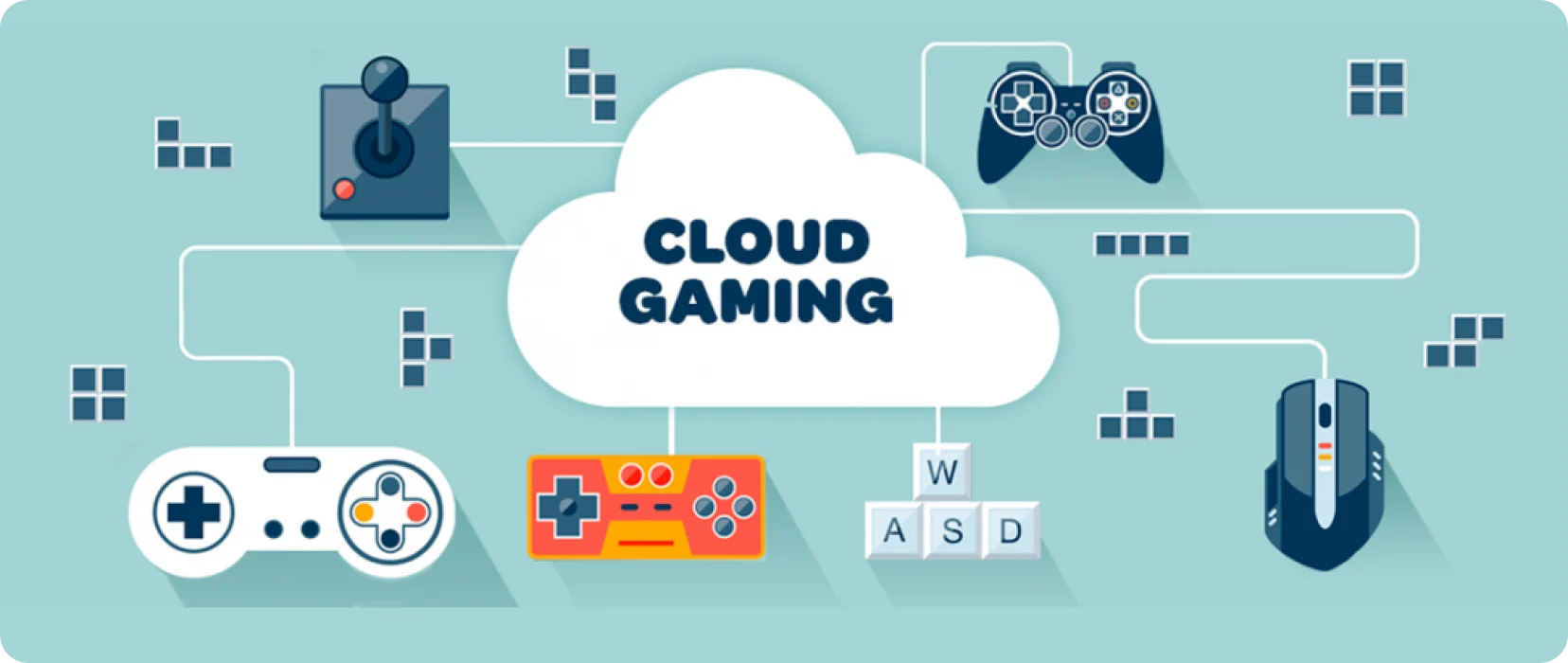
For modern game development, Cloud-based architecture has become the preferred approach, which is replacing traditional on-site setups that demand heavy upfront investment, constant in-house management and limited adaptability to changing player demand. Moreover, by offering elastic computing power, global distribution and integrated development tools, scale automatically. Not only that, but a cloud-based game streaming platform removes these constraints entirely and gives players a free space to enjoy their best time.
Without dropping the performance, the scalability of the cloud gaming ensures studios can handle sudden player surges, launch games confidently and deliver an incredible and enjoyable experience to players worldwide. Alongside this, flexibility allows teams to iterate faster and adapt quickly to player feedback or market shifts while making cloud gaming infrastructure a strategic advancement and a sweet shift in the game development industry.
With the evolution of time and requirement, the advancement in the gaming industry is going crazy. To build a scalable cloud gaming solutions, it is necessary to seek the exceptional cloud services for gamingprovied by the top game development company like Appicoders. And still you are looking for some clarity on developing a scalable cloud games? Lets have a look on the market and user demands for the game streaming platform.
With the evolution of time and requirement, the advancement in the gaming industry is going crazy. To build scalable cloud gaming solutions, it is necessary to work with an experienced mobile app development company in USA that understands cloud-native architecture, real-time streaming, and performance optimization at scale.
Why Build a Cloud Gaming Platform (Market & User Demand)

Cloud gaming is giving the hype to game development industry while redefining how players spend their time playing the game while having the best time of their lives. Instead of investing in high budget consoles and PCs, players can now jump straight into premium titles through a game streaming platform. Here we have an example of Netflix, which has transformed the movie-watching experience for users in an elite way. Thought the type of the application are completely different but these apps have transformes user experiences exceptionally and innovatively. The fututre is already here in the shape of real-time streaming solutions.
Cloud gaming platforms such as NVIDIA GeForce Now, Sony PS Plus and Xbox are already proving that blockbuster AAA titles and indie favorites alike and can run smoothly on everyday devices, powered entirely by high-performance cloud servers.
The role of cloud-based gaming platform is all about giving users or players a relief from hardware. How so? By taking advantage of the portable devices, players can use it as a console. The laptop can become a GPU cloud solution while giving real-time game streaming experiences. And to get access to all these cloud services for gaming, the platform must have to nail the following list:
- Responsiveness: Ideally zero input lag, as if you were playing locally
- Availability: Spin up sessions on demand, anywhere, as fast as possible
- Security: Isolated sessions, encrypted streams
- Consistency: the same experience whatever the device
Moving forward with the technological advancement for cloud gaming performance optimization, our developers have breakdown some essential tech stack so you have a seamless cloud gaming infrastructure.
Launch Your Cloud Gaming Platform—Built to Scale From Day One
Let our experts design a high-performance, cost-optimized cloud gaming solution that handles millions of players effortlessly.
Build My Gaming PlatformCore Tech Stack for a Cloud Gaming Platform
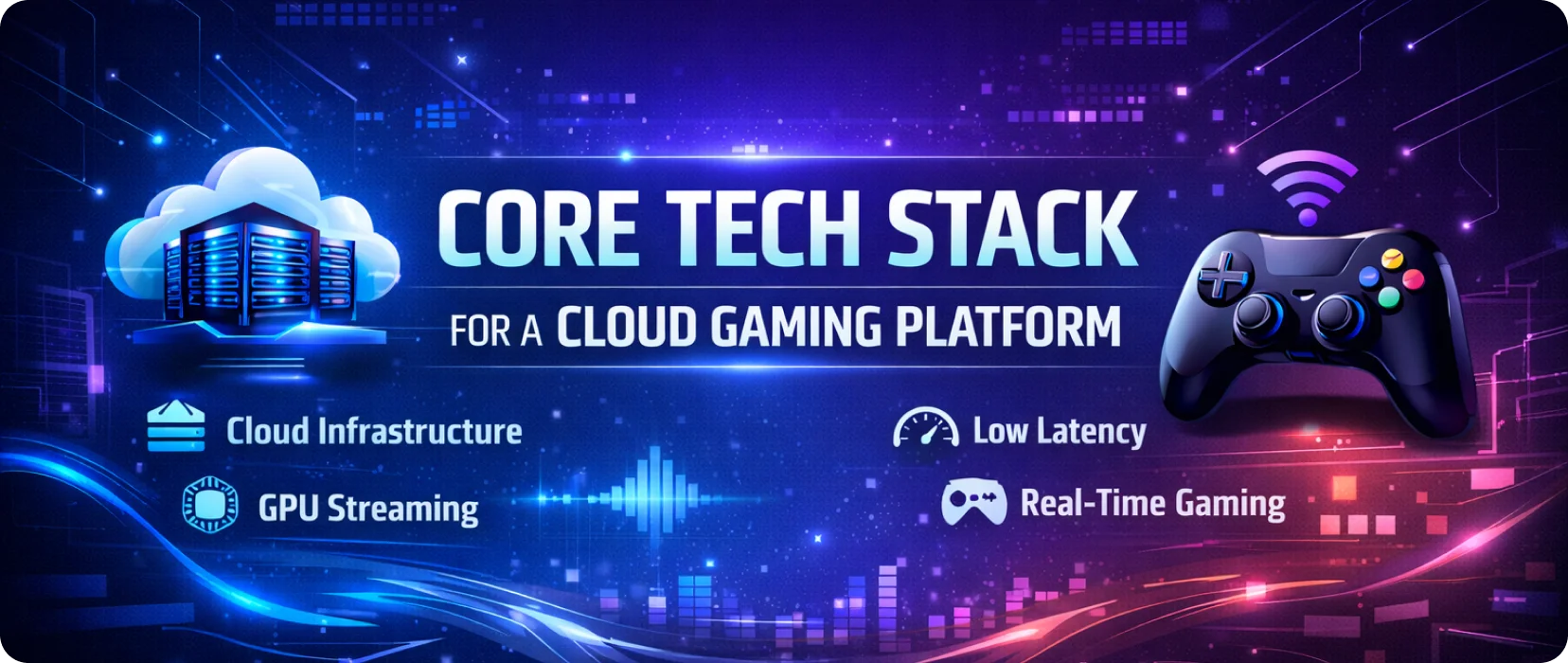
In cloud game development, flexibility is all about maintaining agility by making quick adjustments to infrastructure, deployment procedures, and team workflows in response to changing demands, market trends, and player input. This flexibility is present in many important areas but it is most noticeable in quick deployment. To make games interesting, responsive, and user-focused, this allows the studios to test gameplay changes on specific player groups, monitor engagement in real time and quickly undo anything that doesn't work.
Modern cloud gaming platforms rely heavily on GPU-backed infrastructure, container orchestration, and scalable deployment models, often powered by an enterprise-grade AWS cloud application development service to ensure low latency, high availability, and global reach.
CI/CD Pipelines and Live Ops Integration
Faster iteration cycles are made possible via continuous deployment. By taking advantage of the automated pipelines developers start builds, run tests and deploy easily to staging environments when code is committed.
Still looking for reasons to ensure how CI/CD Pipeline is useful to develop a GPU cloud solutions? Let’s dive in.
1. Cross-platform builds
To ensure consistency across platforms, a single code commit initiates builds for PC, console, mobile, and web.
2. Rollbacks and hotfixes
A one-click rollback returns to the prior version in the event that an update causes problems. Delays can be avoided by deploying critical hotfixes in a matter of minutes.
3. A/B testing
Deploying feature variants to various player groups is made possible by CI/CD. Studios can quickly eliminate ineffective features and analyze engagement or monetization performance.
AI/ML, Analytics, and Customization at Scale
Games are becoming smarter since the latest technologies such as cloud AI and ML has taken over. Without the need for an entire internal data science team, machine learning models may identify cheating, adjust difficulty levels, suggest in-game purchases, and produce more balanced matches by monitoring user behavior in real time.
Cloud gaming platform offer ready-to-use models that simplify setup. Additionally, through user-friendly dashboards, real-time analytics and provide instant insight into player engagement, monetization and system performance while enabling studios to make well-informed decisions. Then, ML Ops frameworks ensure that AI-driven features remain to function when player behavior changes by automating model deployment, monitoring and upgrades.
Now that we have discovered the vital part of building a cloud graming platform, we have breakdown some of the costing criteria depending on the complexities, features and functionalities.
Understanding Cloud Gaming Development Costs & Infrastructure Spend
The cost of building a cloud gaming platform typically ranges from $50,000 to $100,000 for a basic MVP, to get to know how players think about the game, also open a free ground to let them give review about the functionalities. Similarly while depending on the features and functionalities, along with the complexities of the game, the mid-scale solution ranges from $150,000 to $300,000, and $300,000 to $1M+ for a fully featured and enterprise-level platform. In addition, ongoing cloud gaming infrastructure, that mainly focus on GPU cloud solutions and bandwidth, can cost $30,000 to $200,000+ per month, with extra operational expenses of $5,000 to $50,000+ monthly.
Cloud Gaming Platform Development Cost Breakdown
| Platform Type | Estimated Development Cost | Best For |
|---|---|---|
| Basic MVP | $50,000 – $100,000 | Startups testing market demand with core streaming features |
| Mid-Scale Platform | $150,000 – $300,000 | Growing businesses with multiplayer, analytics, and LiveOps |
| Enterprise-Level Platform | $300,000 – $1M+ | Large-scale platforms with global reach and advanced AI features |
Ongoing Infrastructure & Operational Costs
Cost Component
GPU Cloud Servers & Bandwidth
Maintenance & Monitoring
Updates, LiveOps & Support
Estimated Monthly Cost
$30,000 – $200,000+
$5,000 – $20,000
$10,000 – $50,000+
After having a brief information about the game streaming platform, lets jump on the very important part of the game development on which the growth of the application as well as market value of the game relies on which is cloud gaming scalability.
Start Building a Future-Ready Cloud Gaming Platform Today
Get a personalized strategy covering tech stack, costs, and scalability—so you can launch faster and grow smarter.
Schedule a Free ConsultationScalability: Architecture & Load Management
Scalability in game development especially those with the services that starts with a resilient cloud streaming architecture designed to handle growth without disruption. Modern systems use microservices, auto-scaling servers, stackfull workloads and more to distribute load efficiently.
When the umber of player traffic increases, whether from a new launch, update or live event, the cloud gaming infrastructure automatically scales resources to maintain smooth performance.
Furthermore, the advanced load is managed by utilizing tools that helps in balancing traffic, prevent server overloads, and minimize latency while ensuring stable gameplay even under heavy demand.
This approach allows top game productions to support millions of concurrent players while controlling costs and delivering a consistently responsive real-time game streaming experience.
This scalable approach is further strengthened when cloud gaming platforms are supported by robust cloud based web development services, enabling seamless frontend delivery, real-time dashboards, player account management, and cross-device compatibility.
Appicoders’ Proven Strategy for Scalable Cloud Gaming Development
At Appicoders, scalability is engineered into the gaming platform from the beginning. Our approach starts with designing cloud-native architectures that are built to grow seamlessly as the demand of the players increases. By taking full advantage of the cloud streaming architecture, containerization and auto-scaling cloud environments, we ensure that your gaming app can handle sudden traffic, global launches and live in-game events without performance drops or server crashes.
Our game development team carefully configures cloud gaming infrastructure that not only balances performance but cloud gaming costs as well. By using intelligent regional server distribution and GPU cloud solutions for optimization delivers low-latency gameplay all over the world. As player activity graph increases or decreases, resources automatically scale up or down while preventing over-provisioning while maintaining a smooth user experience. This means your game streaming platform performs consistently.
Appicoders also integrates CI/CD pipelines and LiveOps workflows to support continuous growth. By realtime monitoring and analytics, help in managing the workflow easily while updating, patching and adding new features that are deployed without downtime. Moreover, severa other challanges can also be identified and resovlved before they impact on the players. Its not just about it, but we also help businesses to scale in the competitive game market confodently by combining game streaming platform with AI to ensure seamless cloud gaming performance optimization and proactive infrastructure monitoring, At Appicoders, the developes offers cloud services for gaming that delivers high-quality cloud gaming experiences that perform under pressure.
Lastly, creating a smooth game streaming platform requires more than powerful servers, but deveoping a scalable cloud gaming solutions and cloud streaming architecture to maintain high-performance and quality from the beginning. By combining multiple cloud services for gaming, platforms can deliver seamless gameplay even under heavy demand. By ensuring to provide a scalable cloud gaming solutions, our experts are engineered into every layer, Appicoders helps businesses touc the cloud of the success wth reliable performance, grow confidently and stay competitive in a rapidly evolving gaming market.
Fraud Alert
Appicoders Inc. does NOT offer or recruit for online jobs through social media platforms, nor does it pay for app reviews or similar services. Any such offer made in our name is unauthorized and fraudulent, and Appicoders Inc. shall not be liable for any resulting loss or damage.