


Get a summary in:
Nearshore vs Offshore vs Onshore: Going Beyond the Cost Spreadsheet
What if the cheapest custom software development option ends up being the most expensive decision your business makes?
The discussion of nearshore, offshore, and onshore outsourcing frequently begins—and regrettably ends—with hourly rates. On a spreadsheet, a cheaper price tag could seem attractive, but it doesn't take into consideration missed business possibilities, communication difficulties, quality problems, time zone differences, or delayed launches.
In actuality, selecting the best software delivery model is about maximizing value and not just cutting software development costs. The proper partner can help you launch products more quickly, enhance cooperation, lower project risks, and spur innovation. Making the wrong decision can result in expensive revisions, irate teams and missed deadlines that cause the breaking of the bank.
So, how do you decide which software project outsourcing model will align with your business vision, goals and requirements?
To help you make a decision based on strategy rather than just cost, we'll go beyond the numbers in this guide and compare nearshore vs offshore vs onshore development across important factors like cost, communication, talent access, time zone compatibility, quality and long-term business impact.
Nearshore vs Offshore vs Onshore: Understanding the Key Differences
Since people (and marketing teams) frequently use terms loosely, let's make sure we define each one precisely before moving further.
Nearshore Software Project Outsourcing
Working with a global talent pool that has substantial time zone overlap with the continental United States is referred to as "nearshore." This is often Latin America, which includes nations like Mexico, Argentina, Brazil, Colombia, and Uruguay, for obvious reasons. There is only a three-hour difference across time zones. Although hourly rates are higher than the least expensive offshore possibilities, they are still lower than onshore. In terms of rates, LATAM is typically comparable to Eastern Europe.
Offshore Software Project Outsourcing
Working with agile development team who are so far away that you share few or no working hours is known as offshoring. India, the Philippines, and Vietnam are popular offshore sites for American businesses, where hourly rates are often one-third or less of onshore prices. The biggest and most well-established market for contract engineering is offshore, which also provides the best cost-effective software development at scale. Better cost savings are the aim; however, achieving this may present communication and cultural alignment issues.
Onshore Software Project Outsourcing
Working with contractors located in the same nation is known as onshore outsourcing. The agile development team operates under the same commercial and legal standards as you and can be reached during the same working hours. In terms of vendor margins and technical costs, it is the most costly of the three types. However, since hiring a team is significantly less expensive than searching for a global talent pool in San Francisco, there is still some arbitrage opportunity.
Comparing Nearshore, Offshore, and Onshore at a Glance
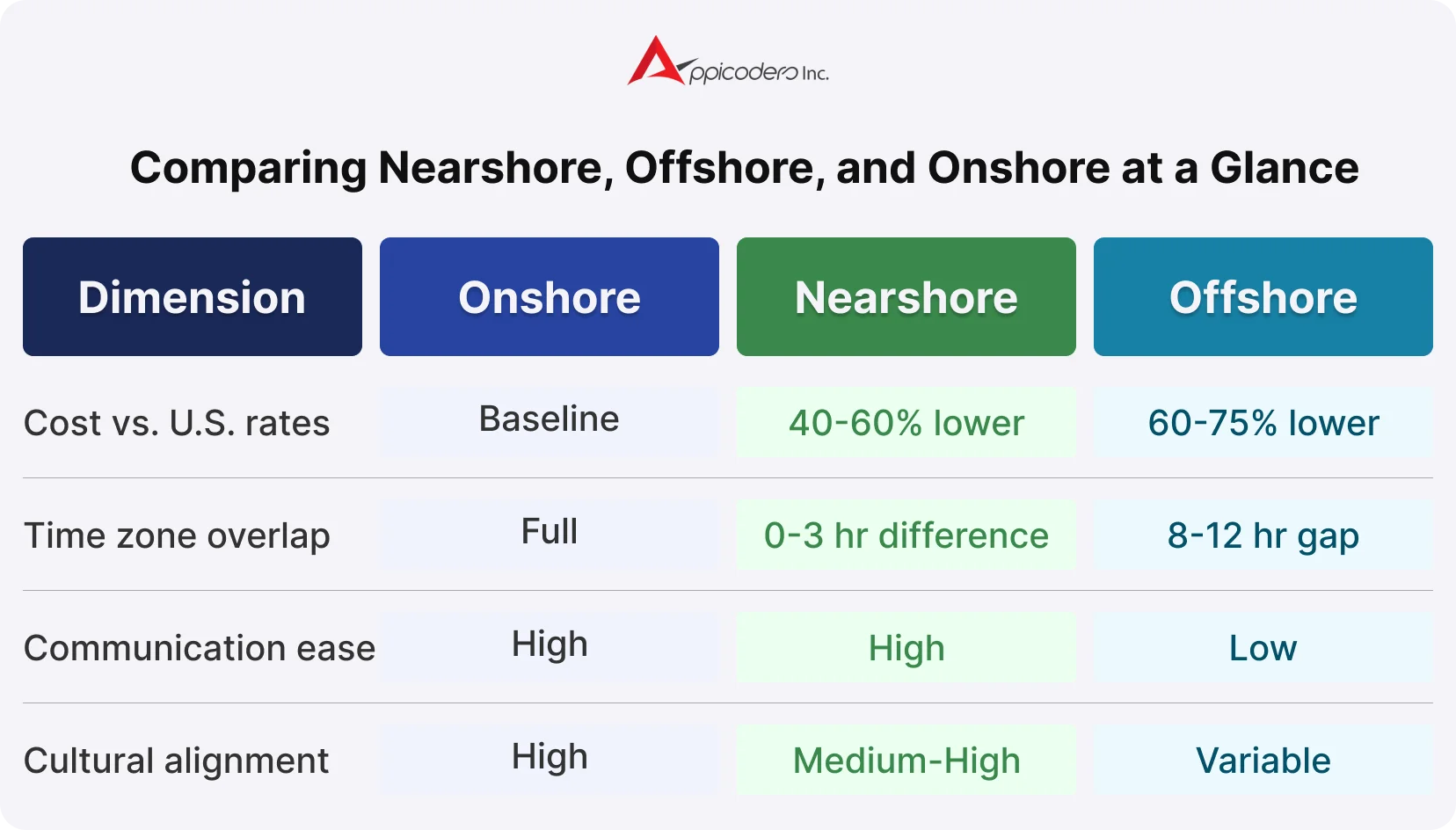
These approaches are typically compared based on factors including cost, communication, cultural fit, time zone overlap, and talent accessibility.
| Dimension | Onshore | Nearshore | Offshore |
|---|---|---|---|
| Cost vs. U.S. rates | Baseline | 40-60% lower | 60-75% lower |
| Time zone overlap | Full | 0-3 hr difference | 8-12 hr gap |
| Communication ease | High | High | Low |
| Cultural alignment | High | Medium-High | Variable |
| Senior talent access | High | Medium-High | Low-Medium |
The Variables That Actually Decide Your Software Project Outsourcing ROI
Cost Savings
According to the Stack Overflow 2025 Developer Survey, engineering managers in the United States make over $200,000, compared to $52,000 in India, an almost four-to-one disparity. However, hourly wages are not the only factor. The entire cost of producing a functional product which includes the time your team spends examining, correcting, and redoing outsourced work, is what matters most. A team that costs 40% less per hour but produces 50% less when integration is taken into account isn't really a good value.
Time Zone Difference
Delivery is more impacted by time zones than many leaders are aware. It affects how everything else functions whether your team is online together most of the time or just occasionally. On a technical level, it expedites problem-solving and iteration; on a human level, it fosters team cohesion and bonding.
Communication
Time zones and communication are closely related, yet they are not the same thing. Language barriers are no longer an issue because the majority of professional engineers speak English fluently.
The problem is how fast and simply teams can participate in ad hoc calls, have casual conversations, respond to Slack messages, brainstorm, and generate ideas. Although async teams frequently miss these opportunities, they are crucial for coordination and alignment.
Cultural Familiarity
Even more crucial is cultural alignment. Because most engineers have developed their talents working with North American clients, Latin American engineering culture is frequently extremely comparable to U.S. business procedures. Teams typically speak up to supervisors, operate autonomously, concentrate on the product, and provide direct feedback.
Different norms may exist in other areas, which may cause miscommunication or require some time to adapt. Great engineers may be found anywhere these days, but it's crucial to find out if your new team shares your work style or if you'll need to spend months modifying expectations.
Talent Availability
In terms of talent access, the industry is now sufficiently developed that top-notch engineers can be found practically anyplace. However, the concentration of particular skills differs by partner and area, such as staff-level infrastructure experts, ML developers with actual production expertise, or senior backend engineers with cloud experience.
Additionally, keep in mind that an excellent global talent pool is in high demand everywhere, so if you're searching for a unicorn, don't expect low prices and simple sourcing.
Which Software Delivery Model Is Right for Your Business?
None of this indicates that a single winner is obvious. There are circumstances in which each software delivery model works best.
| Scenario | Best fit |
|---|---|
| Regulated work requiring U.S. personnel | Onshore |
| Short engagement, under 3 months | Onshore |
| Product team needing daily collaboration across product, design, and engineering | Nearshore |
| Scaling by 10-20+ engineers while maintaining team cohesion | Nearshore |
| Large, well-structured delivery streams with clear boundaries | Offshore |
| Mature org running follow-the-sun development | Offshore |
| Core team needs real-time collaboration, secondary streams are well-defined | Nearshore + Offshore |
When Onshore Is the Best Fit
When the work is strictly regulated or when U.S. professionals are needed for compliance and security reasons, onshore is the best option. Additionally, it's the ideal choice for brief projects where the overhead of assembling a remote team isn't worth it, for engagements where the customer contract requires physical presence, and for minor additions to an already-existing team when the premium is negligible in terms of actual money.
When Offshore Is the Best Fit
For large-scale work that can be divided into distinct, well-bounded streams and doesn't require continuous real-time cooperation, offshore is the ideal option. Additionally, it works well for businesses with qualified management that can effectively implement a follow-the-sun strategy. For decades, large corporations have been doing this well, and the best of them run something akin to a truly integrated global engineering organization. It's difficult, and a lot of mid-sized businesses don't realize how much work it takes to succeed.
When Nearshore Is the Best Fit
For the majority of agile development team in the United States, nearshore is typically the best option. Real-time collaboration is crucial for firms expanding their technical teams and modernizing their delivery methods. Conversation is used to design features. Problems are fixed in a matter of minutes. When your team is online simultaneously, pair programming, code reviews, planning, retrospectives, and the day-to-day tasks of a modern engineering team augmentation all run more smoothly.
Conclusion
Choosing between nearshore, offshore, and onshore software project outsourcing is about much more than finding the lowest hourly rate. The right software delivery model depends on your business goals, collaboration needs, project complexity, and long-term growth strategy. While offshore can maximize cost savings, onshore offers unmatched proximity, and nearshore often provides the best balance of affordability, real-time collaboration, and access to skilled talent. By evaluating the total value—not just the upfront cost—you can build a development partnership that delivers faster releases, higher quality, and lasting business success.
Fraud Alert
Appicoders Inc. does NOT offer or recruit for online jobs through social media platforms, nor does it pay for app reviews or similar services. Any such offer made in our name is unauthorized and fraudulent, and Appicoders Inc. shall not be liable for any resulting loss or damage.