

Get a summary in:
HL7 vs FHIR: What Healthcare App Developers Need to Know
For many years, HL7 has served as the foundation for the interchange of healthcare data. In last 20 years of healthcare app development, you must have worked with any hospital system who have most likely dealt with HL7 v2 messages transiting via MLLP connections.
But with the evolution of technologies and advancements of tools, the more recent standard that everyone is discussing is FHIR. It is created for the API economy, is contemporary and is REST-based.
In actuality, though, a lot of healthcare institutions still employ HL7 v2 for critical workflows. If you were creating a healthcare application today, which standard would you truly strive for? And what happens if you find that you need to support both of your clients and they won't migrate overnight?
Let's dissect this most interestingly by taking advantage of the exceptional skill sets of our experts at healthcare mobile app development company, Appicoders, so that it truly aids in your decision-making.
What HL7 v2 Actually Is?
The same group that still upholds healthcare interoperability standards today, HL7 International, created the pipe-delimited message format known as HL7 version 2 in the 1980s. Segments, fields, and components are divided by pipes and carets in this format. The appearance of an HL7 v2 ADT message differs greatly from that of a contemporary API response. It is a pipe-delimited, flat string that can only be read by a specialized parser.
HL7 v2 is still widely used despite its age. In thousands of hospitals, HL7 v2 is used for radiology reports, order management, admission discharge transfer notifications, and lab results. Instead of using HTTP, the messages are usually sent using MLLP, a minimum lower layer protocol. This implies that you can't simply call an endpoint and receive JSON in return. To manage the connection, you require either a specific listener or an interface engine.
What Is FHIR?
The term FHIR stands for Fast Healthcare Interoperability Resources, which is a REST-based standard that employs contemporary web technologies like JSON, XML, HTTP verbs and whatnot. Instead of delivering messages, FHIR uses resources such as patients, observations, medicine requests and more.
FHIR was intended for interoperability among systems, not only point-to-point messaging. It also tackles the complexities of healthcare data and presents it in a style that any web developer or mobile app development company offering healthcare services can understand. You don't require a specialized data interpreter; only an HTTP client. This makes FHIR an excellent choice for the API economy, mobile apps, patient portals, and cloud-based analytics tools.
HL7 vs FHIR Key Differences
Healthcare data interchange is made possible via both HL7 FHIR integration, albeit they employ distinct methods. FHIR makes advantage of contemporary REST APIs using JSON and XML, whereas HL7 v2 depends on conventional, pipe-delimited messaging. Although many healthcare organizations still rely on HL7 v2, FHIR is becoming popular for new apps and connections. Supporting both standards is therefore frequently crucial.
HL7 vs FHIR: The Side-by-Side Breakdown
| Factor | HL7 v2 | FHIR R4 |
|---|---|---|
| Released | 1989 | 2019 (R4) |
| Format | Pipe-delimited text | JSON / XML / Turtle |
| Transport | MLLP (TCP/IP) | HTTPS REST API |
| Data Model | Message segments (MSH, PID, OBR) | Resources (Patient, Observation, Claim) |
| Developer Familiarity | Requires healthcare-specific training | Any REST API developer can learn it |
| Current Adoption | 95%+ of hospital systems | Mandated for new integrations |
| Flexibility | High — lots of local variation | Standardized with defined profiles |
| Real-Time | Event-driven messaging | REST, WebSockets, SMART launch |
| Patient Access | Not designed for it | Core use case |
| Mobile/Web Apps | Not suitable | Designed for it |
| Regulatory Requirement | Legacy compliance | CMS/ONC mandated (21st Century Cures) |
| Learning Curve | Steep — healthcare-specific | Moderate — familiar REST patterns |
Decode HL7 v2: The Message Types That Power Healthcare Data
If you design any system that involves a hospital or major clinic, you will encounter the following HL7 v2 message types:
ADT Messages (Admit, Discharge, Transfer)
In every medical setting, these are the most prevalent HL7 messages. Patient admittance is ADT^A01. Patient transfer is ADT^A02. Patient discharge is ADT^A03. The patient information update is ADT^A08. To keep patient records up to date, all downstream systems which includes billing, lab, pharmacy, and radiology, listen for ADT messages.
ORU Messages (Observation/Result)
Lab results, radiological reports, and other clinical observations are returned to the ordering system and the EHR by ORU^R01. Your lab findings are transmitted as ORU messages.
MDM Messages (Medical Document Management)
Discharge summaries, surgical reports, and transcribed notes are among the clinical documents that MDM^T02 transports between systems.
SIU Messages (Scheduling Information Unsolicited)
Events related to appointment scheduling are handled by SIU^S12 through S26. SIU messages alert linked systems when an appointment is scheduled, changed, or canceled.
Cracking FHIR: Must-Know Resources for Health Tech Developers
Here we have listed some of the clinical and administrative data that is to be typed as resources by FHIR.
Patient. A person's demographic details. Name, address, gender, DOB, and identifiers. Every healthcare workflow's cornerstone.
Practitioner and PractitionerRole. Information about the provider which includes the clinician's name and position within a particular organization or site.
Encounter. A clinical interaction between a healthcare professional and a patient. Encounters include telemedicine sessions, ER visits, outpatient stays, and inpatient stays.
Observation. Vital signs, test results, social history answers, and evaluation scores are examples of clinical measurements and findings, among the most popular FHIR resources.
HL7 or FHIR? A Developer's Guide to Choosing the Right Standard
For the majority of development projects, this is the practical question that truly counts.
Use HL7 v2 when:
When interfacing with current hospital systems, such as EHRs, labs, radiology, and pharmacy platforms, use HL7 v2. For real-time hospital workflows like ADT events, lab findings, and orders, it is still the norm. HL7 v2 is frequently necessary if you're connecting to established infrastructure.
Use FHIR when:
When developing healthcare applications that target patients specifically, EHR-integrated solutions or new healthcare infrastructure utilizing contemporary web standards, choose FHIR. Additionally, it is perfect for bulk clinical analytics, CMS/ONC-compliant data access, and payer connections via FHIR APIs.
Use both simultaneously when:
You are developing an HMS or enterprise clinical platform that must expose contemporary APIs for patient-facing applications and third-party integrations (FHIR) in addition to receiving real-time events from hospital systems (HL7 v2). The majority of enterprise healthcare IT initiatives nowadays operate in this manner.
Can HL7 and FHIR Coexist? Bridging Old and New Standards
Indeed, in actual healthcare settings, HL7 v2 and FHIR frequently collaborate. HL7 FHIR integration engines are capable of exposing FHIR APIs for contemporary applications av nd converting HL7 v2 messages into FHIR resources. However, because HL7 implementations differ, mapping between the standards necessitates careful configuration and testing.
HL7 FHIR Integration: The Mistakes That Trip Up Even Good Developers
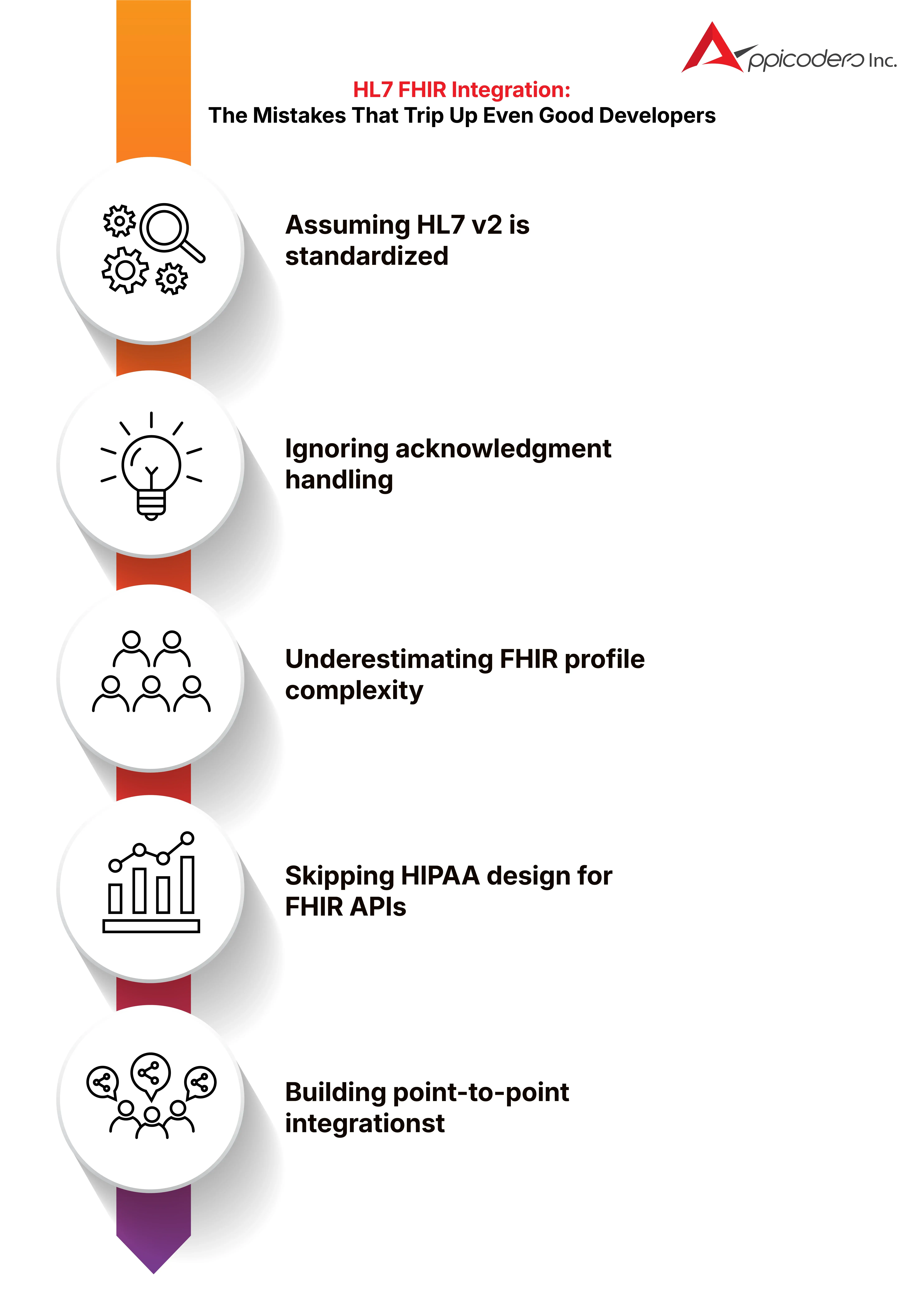
When working with HL7 and FHIR, development teams frequently make the following errors:
Assuming HL7 v2 is standardized
HL7 v2 permits a great deal of local customization. It is possible for two hospitals to develop entirely distinct message structures while claiming to send "standard" HL7 ADT messages. Obtain example messages from the source system before to, not after, developing your interface.
Ignoring acknowledgment handling
ACK messages are used by HL7 v2 to verify receipt. Inadequate ACK handling will cause systems to silently lose messages. A patient record that is not updated because to a missing ADT event downstream has serious clinical repercussions.
Underestimating FHIR profile complexity
US Core profiles, Da Vinci profiles, SMART on FHIR launch—FHIR in the US has a multi-layered profile ecosystem that surpasses the baseline. In particular, US Core introduces terminology bindings and must-support criteria that all US implementations must manage.
Skipping HIPAA design for FHIR APIs
PHI is exposed via HTTP by FHIR APIs. To comply with HIPAA technical safeguard standards, each FHIR endpoint must have appropriate authentication (OAuth 2.0/SMART), authorization scopes, TLS encryption, and audit logging. This is not a choice.
Building point-to-point integrations
An unmanageable web of integrations is created when System A is connected directly to System B, then System A to System C, and finally System B to System D. The complexity increases exponentially with each subsequent system. This is appropriately handled by a central integration engine.
Final Words
HL7 v2 and FHIR are not competing standards but complementary technologies shaping healthcare interoperability. While HL7 v2 remains essential for legacy hospital systems and real-time workflows, FHIR is driving modern APIs, mobile apps, and patient-facing solutions. For healthcare app developers, supporting both can deliver greater compatibility, flexibility, and long-term value.
Ready to Build a Healthcare App with HL7 & FHIR?
Whether you're integrating with legacy hospital systems or building modern patient-facing apps, our experts can help you navigate the complexities of healthcare interoperability. Let's make it seamless from the start.
Contact us today for a free consultationFraud Alert
Appicoders Inc. does NOT offer or recruit for online jobs through social media platforms, nor does it pay for app reviews or similar services. Any such offer made in our name is unauthorized and fraudulent, and Appicoders Inc. shall not be liable for any resulting loss or damage.