

Get a summary in:
Native vs Cross-Platform App Development: What Houston Businesses Should Know
Houston's business landscape is moving fast, and companies are racing to put powerful tools in the hands of their customers and teams. But one wrong decision made in the time of your app development journey can quietly cost you months of rework, a blown budget and a product that feels off from day one. That decision? Choosing between native vs cross-platform app development in Houston.
Most Houston business owners come to this question with the same instinct: just build the app no matter what. And that instinct isn't wrong, but the "how" matters enormously. Getting the platform strategy right means understanding your business first and your tech stack second.
If you are looking for a way to develop a mobile app for two different platforms, such as iOS and Android, then the Native apps development approach comes in, which delivers unmatched performance and deep device integration, but it can run two to three times the cost of a single cross-platform build.
Cross-platform, on the other hand, lets you ship to both platforms from one codebase while cutting your timeline and budget significantly without the dramatic quality trade-offs that plagued earlier tools.
So, which approach would you be choosing for your Houston business? That depends entirely on your business's vision and goals, and, most of all, on who it serves and how quickly you need to move. In this guide, we will break down every crucial detail that will help you walk away with a clear picture and help you make an informed decision and choose the best one that perfectly aligns with your business and market needs.
Not sure which path fits your Houston business?
Let's figure it out together. Our team has helped companies across Houston's energy. So, book a free strategy call today and get clarity before you commit.
Book a Free Strategy CallNative App Development
Native application development is the process of leveraging cutting-edge programming languages, tools, and frameworks created especially for a single platform, like iOS or Android, to create mobile apps. An iOS app won't function on Android, and vice versa, since native apps are designed for certain operating systems.
Although some historical apps still use C#, Swift, Apple's iOS SDK, and development environments like Xcode or AppCode are the main tools used by developers for iOS development.
On the Android hand, Appicoders' app developers in Houston usually use Java or Kotlin, with Kotlin becoming the favored current language, although Java is still used in many mobile apps. Google's Android SDK and developer tools like Android Studio or IntelliJ IDEA facilitate Android development.
Developers can deliver optimal speed, flawless user experiences, and full access to device features with this platform-specific approach.
Why Choose Native Apps?
Let's Explore the Pros and Cons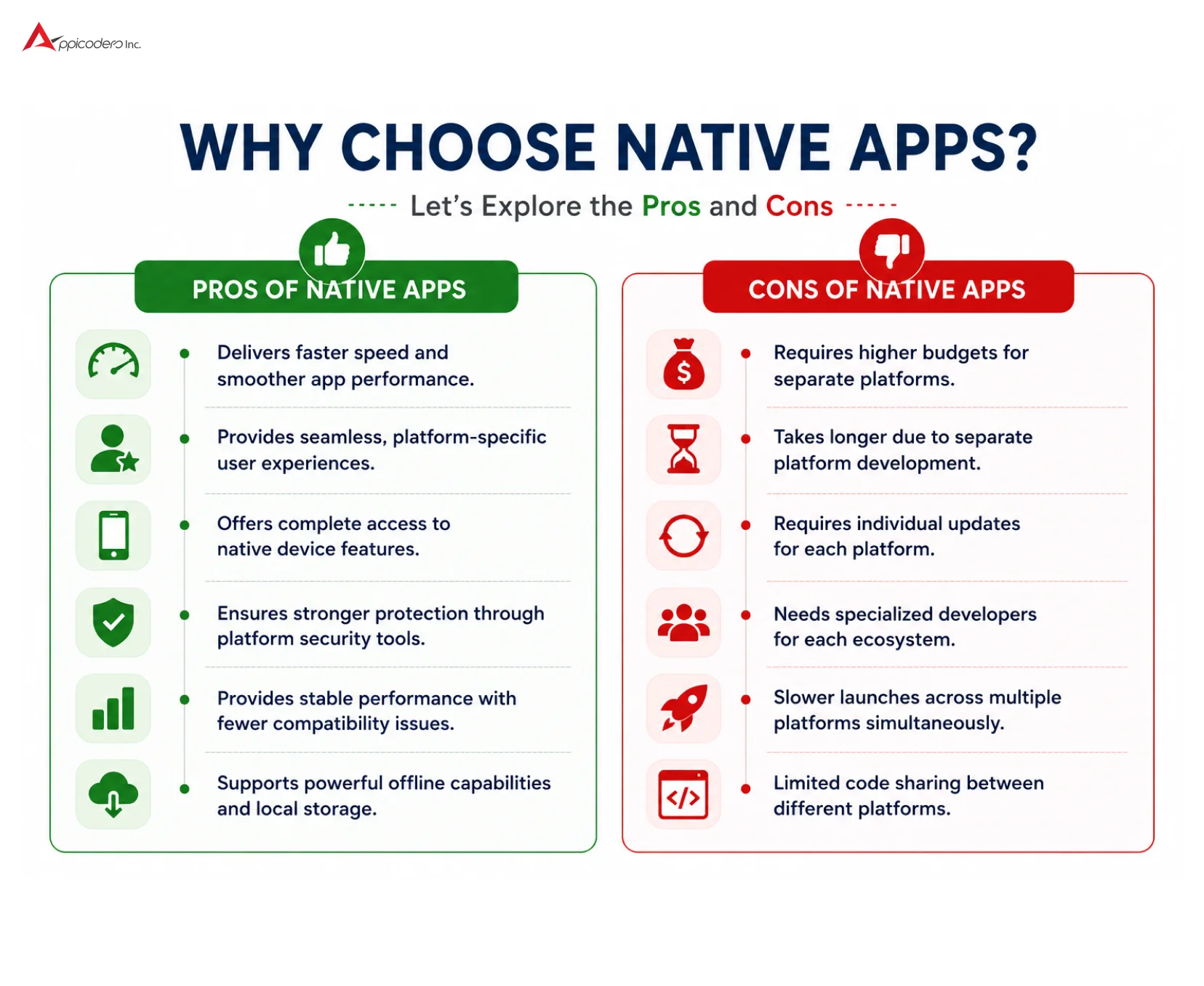
| Pros of Native Apps | Cons of Native Apps |
|---|---|
| Delivers faster speed and smoother app performance. | Requires higher budgets for separate platforms. |
| Provides seamless, platform-specific user experiences. | Takes longer due to separate platform development. |
| Offers complete access to native device features. | Requires individual updates for each platform. |
| Ensures stronger protection through platform security tools. | Needs specialized developers for each ecosystem. |
| Provides stable performance with fewer compatibility issues. | Slower launches across multiple platforms simultaneously. |
| Supports powerful offline capabilities and local storage. | Limited code sharing between different platforms. |
Cross-Platform App Development
By using a shared codebase, cross-platform mobile app development entails creating a single mobile application that runs on several operating platforms, which includes iOS and Android.
Developers accomplish this by combining platform-specific SDKs with cross-platform frameworks like React Native, Flutter and Xamarin to promise device compatibility. Modern frameworks have greatly outperformed prior cross-platform solutions for Houston, which frequently suffered from performance issues and limited access to native UI elements, but not anymore with the advanced mobile technology for Houston businesses.
Why Choose Cross-Platform Apps?
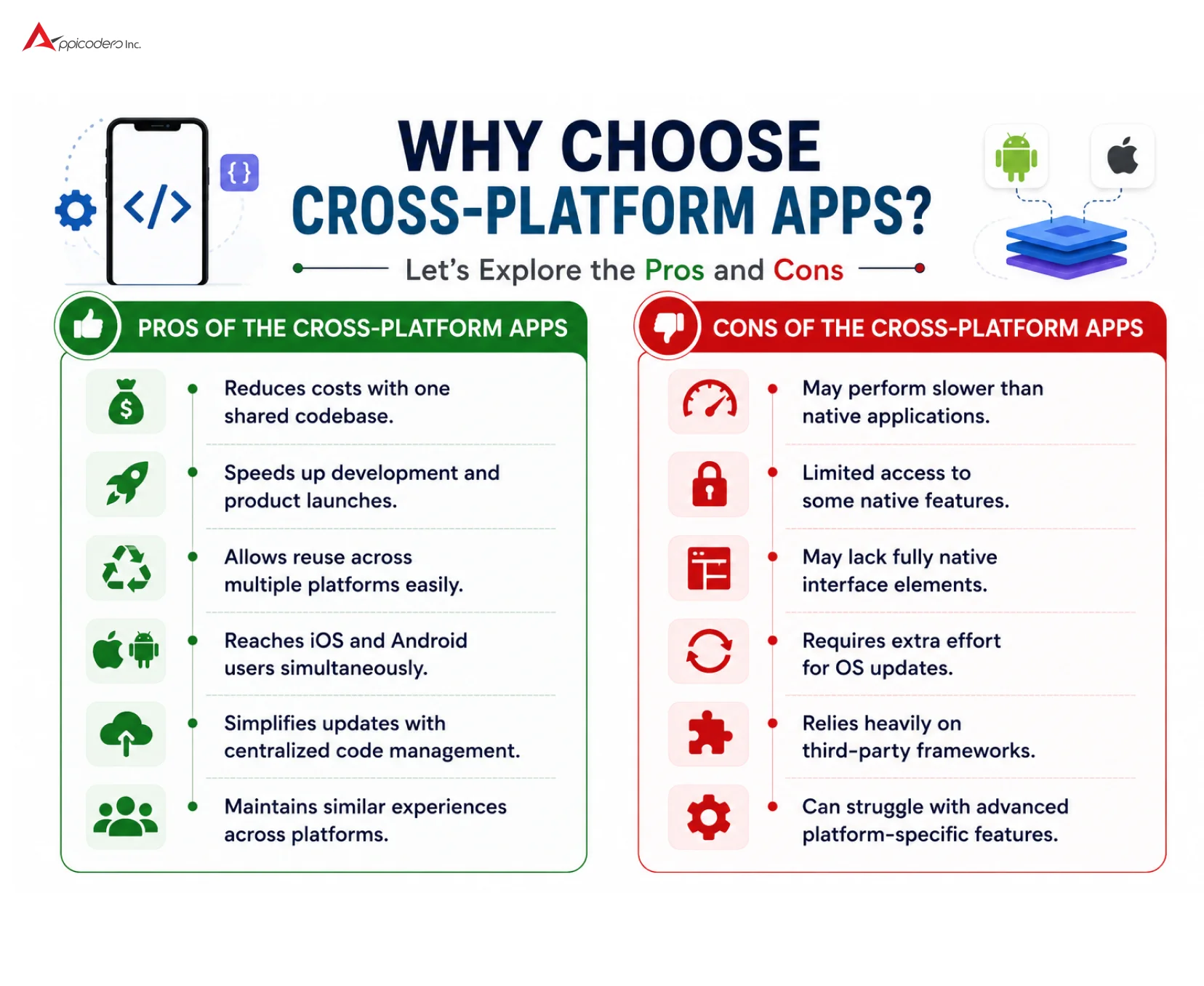 Let's Explore the Pros and Cons
| Pros of the Cross-Platform Apps | Cons of the Cross-Platform Apps |
|---|---|
| Reduces costs with one shared codebase. | May perform slower than native applications. |
| Speeds up development and product launches. | Limited access to some native features. |
| Allows reuse across multiple platforms easily. | May lack fully native interface elements. |
| Reaches iOS and Android users simultaneously. | Requires extra effort for OS updates. |
| Simplifies updates with centralized code management. | Relies heavily on third-party frameworks. |
| Maintains similar experiences across platforms. | Can struggle with advanced platform-specific features. |
Still weighing your options?
That's exactly where we can help. Share your app idea with us, and we'll tell you honestly which approach makes the most sense for your goals, timeline, and budget. Let's start the conversation.
Share Your App IdeaNative vs. Cross-Platform: Which One Should Houston Businesses Choose?
Native development simply means building two separate apps with a fully optimized platform. It offers superior performance, seamless device integration, and a polished user experience. And above all, for Houston businesses in diverse industries, which include oil and gas, healthcare, or industrial operations where reliability and hardware access are non-negotiable, native is often worth the higher investment.
Whereas, cross-platform development uses a single codebase that runs on multiple platforms simultaneously. Frameworks like Flutter and React Native have matured significantly, delivering near-native performance at a fraction of the cost. For Houston retailers, service businesses, or startups that need to reach customers on both iOS and Android quickly and affordably, cross-platform is increasingly the smarter move.
For most small to mid-sized Houston businesses, cross-platform offers a stronger return on investment (ROI). And for enterprise-level operations with complex technical requirements, native earns its cost. And for businesses sitting somewhere in the middle, a hybrid approach is quickly becoming the go-to strategy across Houston's tech ecosystem.
Conclusion
Understanding your audience, budget, long-term vision, and company objectives is crucial when deciding when to develop Houston business mobile solutions. Native apps are perfect for companies with complicated requirements and a strong demand for platform-specific capabilities since they offer unparalleled performance, security, and device integration.
However, cross-platform apps are a sensible option for companies wishing to launch their first-ever app effectively across several platforms because they offer quicker development, lower costs, and a wider market reach. The greatest plan for Houston businesses is to choose the solution that best fits their users, growth strategy, and operational needs rather than the newest technology. A well-considered mobile technology for Houston businesses chosen now can result in a successful and dependable mobile experience later on.
FAQs
What is the difference between native and cross-platform app development?
Native app development builds separate apps for each platform using platform-specific languages and tools, while cross-platform development uses a single codebase to deploy on multiple platforms simultaneously.
Which is more cost-effective: native or cross-platform?
Cross-platform development is generally more cost-effective as it requires a single codebase and one team, whereas native development requires separate teams and budgets for each platform.
When should a Houston business choose native app development?
Native is ideal when you need maximum performance, deep device integration, or access to platform-specific features, especially for industries like healthcare, energy, or industrial operations.
Is cross-platform app development suitable for startups?
Yes, cross-platform is often the preferred choice for startups as it allows faster time-to-market and lower development costs while reaching both iOS and Android users simultaneously.
Can cross-platform apps match native performance?
Modern frameworks like Flutter and React Native deliver near-native performance for most applications. However, for graphics-intensive or highly complex apps, native may still offer a slight edge.
Fraud Alert
Appicoders Inc. does NOT offer or recruit for online jobs through social media platforms, nor does it pay for app reviews or similar services. Any such offer made in our name is unauthorized and fraudulent, and Appicoders Inc. shall not be liable for any resulting loss or damage.